
Transform ordinary stories into extraordinary ones with our proven 7-step method. Join thousands of storytellers on their journey to mastery.

Ramli Ibrahim, the legendary odissi dancer, narrates the journey that women choreographers in odissi have taken and the central role that Sutra Foundation has in bringing them to the fore.
 [This story is published here with the author's permission.]
In April 2011, Sutra Foundation staged Odissi Stirred at the Kuala Lumpur Performing Arts Centre. The newspapers reported that, ‘true to the art, the choreographer is inspired by the Odissi tradition and reveals its rural and folk charm, incorporating elements of its originality while transcending into modernity as the moves are mesmerisingly surreal and captivating.’
The production included a 20-minute composition commissioned by Sutra called Pallavan which was choreographed by Madhavi Mudgal. She performed it alongside Evocations by Sharmila Biswas.
Many were unaware that this was the beginning of a paradigm shift. It was the first time that Malaysians saw odissi choreographed by women. Indeed, the word ‘choreography’ was either not understood or taken for granted.
For a long while, the gurus and dance-makers of odissi tended to be male. Generally, male dancers learn odissi in order to become gurus; not many can compete with the women as dancers. Performing the standard solo repertoire of odissi, the women dancers were always the ‘par excellence’ interpretive vehicles of lyrical odissi, but hardly ever ventured into the realm of dance making in odissi. Until now.
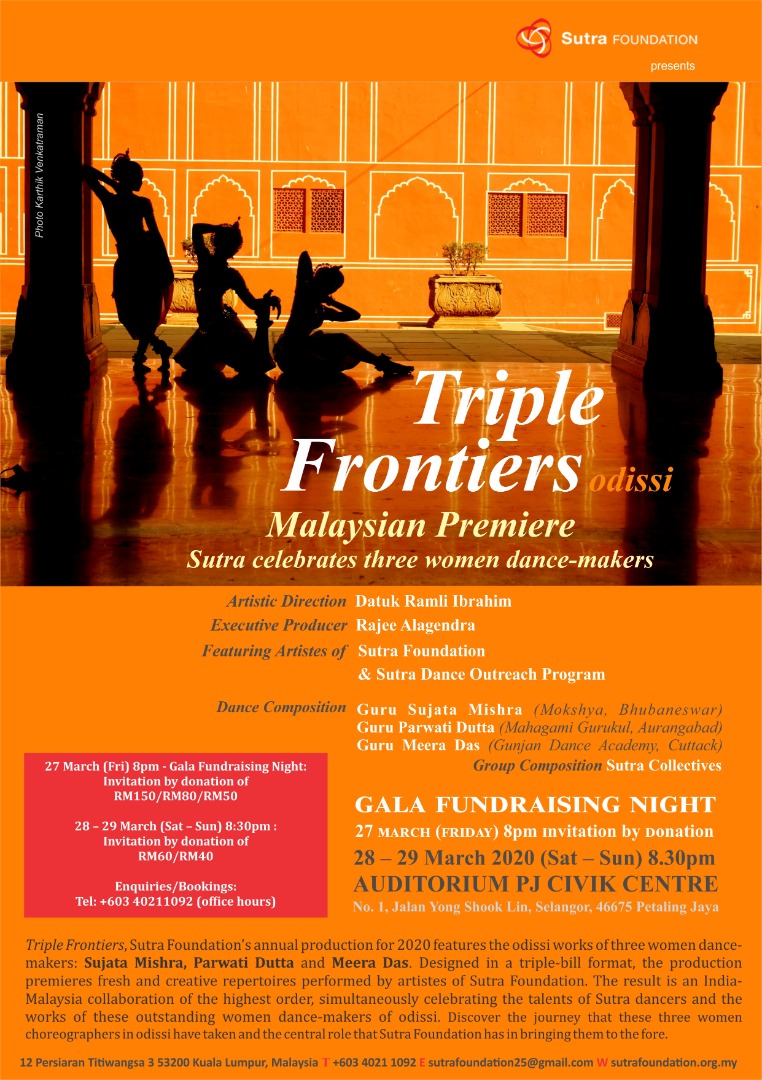
Triple Frontiers, Sutra Foundation’s annual production for 2020 features the odissi works of three women dance-makers from India: Sujata Mishra, Parwati Dutta and Meera Das.
PUSHING BOUNDARIES
The importance of this development in the evolution of odissi can fully be appreciated when one understands these dance-makers’ journeys thus far. Over the last five decades or so, they have steadily pushed the boundaries and ventured into new frontiers.
In the late 1970s, very few Malaysians were exposed to odissi works. Those who were lucky enough, might have seen the spellbinding odissi performance of Dasavatar by Chandrabhanu when he first danced the powerful depiction of the ten incarnations of Krishna.
However, it was through Sutra that the larger population of Malaysia became familiar with this exquisite Indian classical dance form from East India, which was based on the methodology of one of the three pioneer giants of odissi, Guru Debaprasad Das. The other two were Gurus Pankaj Charan and Kelucharan Mahapatra.
The creative spectre of these three pioneer giants of odissi loomed large, such that few repertoires from their disciples would emerge and survive within the shadow of their genius. Their disciples, in the capacity of novice gurus and dance-makers, either did not want to or were unable to challenge the supremacy of their masters. In Odisha, experiments were usually met with vehement resistance.
By the time the three pioneer gurus were no more, odissi has already consolidated its methodology of teaching. With the popularity of odissi world-wide, the new dancers-gurus also began to travel internationally and make their presence felt. Still, they were all mainly male whose focus was often teaching.
QUANTUM LEAP
Then came the quantum leap when a fresh and innovative repertoire from the younger gurus came of age. For example, Durga Charan Ranbir, Gajendra Kumar Panda, Bichitrananda Swain and Ratikant Mahapatra are among many male gurus who have been taking the creative mettle of creating new works. Aruna Mohanty exercised her creative talents and established herself as a dance-maker and director of import when she took over the helm of Odissi Dance Academy.
Simultaneously, a fresh ‘branding’ of odissi dance and music was being established here in Malaysia. Soon after Debaprasad Das passed on, Sutra’s relationship with this parampara progressed into another phase. We commissioned several benchmark new repertoires from Guru Gajendra Kumar Panda, arguably Debaprasad Das’s closest disciple and performed them in Odisha, thereby creating a sensation.
The next stage came about when Sutra enlisted the creative input of Guru Durga Charan Ranbir, another senior disciple of Debaprasad Das. We commissioned a number of strong works that further extended Sutra’s foray into this rare parampara.
In the process, Sutra’s distinctive and innovative group compositions have influenced internationally how odissi is viewed in a large theatre and outdoor performing spaces. These have set us apart from others as a brand which is both unique and cannot be replicated, as yet. Therein lies the ‘Sutra Factor’.
Within 35 years of odissi being first performed under the banner of Sutra, it became a favourite Indian classical dance performed frequently on stage both with local and overseas dancers. It also became a favourite with audiences, placing it on par with the more established bharatanatyam
ULTIMATE GIFT
Enter into the picture in early 1990s, Sujata Mishra, Parwati Dutta and Meera Das. Today, they run their own successful dance institutions in India and have dedicated at least three to four decades of their lives to odissi. They represent the two major paramparas of the late Debaprasad Das and Kelucharan Mahapatra.
At the start of their careers as exceptionally gifted dancers, they were singled out by their gurus in the guru-sishya parampara tradition. They absorbed the style of their mentors, grew into the mould of their pioneering gurus and subsequently become teachers of odissi in their own right, imparting their hard-earned knowledge to their young students. Soon, they found that they were embarking on the less-charted territory of choreography and eventually contributing their own colours and hues to the creative fabric of the odissi parampara that had cultivated them.
Sutra contributes its inimitable mark in Triple Frontiers to the works by these three women choreographers. Sujata, Parwati and Meera personally taught the senior Sutra dancers under my mentorship. Having learnt the repertoire as a solo form, the works now face another round of transformation as they are interpreted as group compositions (with permission of the three dance-makers). In order that all of Sutra’s talented dancers are featured in this new repertoire, more than 16 of its 24 dancers on stage will comprise of the young dancers from Sutra’s Outreach Programme.
The result is an India-Malaysia collaboration of the highest order which simultaneously celebrates the talents of the Sutra dancers and the works of these outstanding dance-makers of odissi. Triple Frontiers is ultimately a gift by Sujata, Parwati and Meera.
Ramli Ibrahim
(25 February 2020)
***
What: ‘Triple Frontiers’ (A celebration of 3 women dance-makers)
Where: Auditorium PJ Civic Centre, No. 1, Jalan Yong Shook Lin, Petaling Jaya, Selangor 46675
When: 27 to 29 March, 2020.
For more information, please visit: www.sutrafoundation.org.my
 David Ananda (Published with Permission)
It's been just over two years since Aneeta and I first met. I was the subject of her article 'All Paws For A Support System', published in New Straits Times in March 2017. She gave me the privilege of sharing with her the story of 'Pawse For A Cause', a project I founded that brings the entertainment industry together to raise resources for needy animal shelters.
Since then, I have also founded the 'ALIVE' Project with my partner David Ananda. This is an animal initiative that focuses on strategic solutions for the animal community with a large focus on the 3 Rs - Rescue, Rehabilitation and Rehoming of strays and shelter dogs.
David and I met about three years ago. Our shared passion for animals spurred a working partnership that eventually evolved into a personal one. While my strengths lie in PR and social skills, David's lie in something deeper. He is a gifted dog behaviourist with a special ability to establish human-dog communications.
David was quite content to live on a farm in Ipoh with our 38 dogs. At my insistence, he sent in his application to take part in a programme ‘Cesar’s Recruit Asia, Season 3’. Never in a million years did he expect to receive an email congratulating him on being shortlisted. A Skype call with the shows head producer convinced her that David was the man Cesar was looking for. He was selected as the contestant representing Malaysia alongside seven other contestants from across Asia.
What exactly is ‘Cesar’s Recruit Programme Asia, Season 3’ about?
 Cesar Millan and David Ananda (Published with Permission)
Well, Cesar Millan is the most recognised dog behaviourist in the world. He has spent decades studying a dog’s psyche. With that knowledge, he places emphasis on training humans first in order to successfully rehabilitate dogs.
Over the years he has used his growing influence to create awareness on animal rights, rehoming of stray and shelter dogs and teaching people the importance of trust, love and respect in building healthy and happy human-dog relationships. With Asia fast becoming a region with a booming animal industry that generates billions, Cesar, and by extension his recruits, aim to find others to spread his knowledge.
In David’s Words…
"I remember watching him on TV and thinking, man, this guy, how did he do what he does? Never did I ever think I was going to be ON TV with him, discovering the answer to that question," says David.
"My mum always told me I had a gift with animals. She was my first dog whisperer, nurturing every stray puppy or kitten I'd bring home on my way back from school. I didn't understand what she meant by that, but I did know that I had an innate ability to connect with them. People thought I was mad, but she didn't. She would just smile and say, 'someday you'll understand'. And she was right.
“Being on this show totally flipped me over my head. I finally understood what she meant because Cesar saw it too. I always knew I wanted to work with animals but I didn't know how or in what way, and this experience has shown me my calling.
“Animals are so simple. It's humans that are complicated. All of us have the ability to communicate with dogs. We just don't know how. More importantly, we don't know why. But if we did finally understand why, we would be able to grasp the universal truth that it is us humans that hold the power to create and sustain a better planet, not just for us but for every living thing.
“Dogs are magic, capable of changing a human being in ways another human or animal species cannot. If we can incept the human mind that we are here to protect them while they teach us about our humanity, the world will be a far better place. That is what I want to teach the world.
I've gone the furthest any Malaysian has on a platform as far-reaching as this. It's ironic that Malaysia and China are in the finals as both countries have their own 'bad image' where dogs are concerned. And yet, no matter what the outcome, Larry has become a brother to me and from where we stand, we have both proudly shown the world that our countries are very capable and ready to stand up against animal cruelty and persevere in making the world a safer place for our canine companions. For us, we have both already won, and I couldn't be prouder standing at the finish line with him.”
In less than two weeks from that first application, he was on the way to Singapore to take part in a competition that would push his skills and self-belief to its limit. The programme spanned six gruelling weeks that tested every contestants’ skills to the limit. Every week, one by one, the contestants were eliminated. David has done the country proud by making it to the finals, being the first Malaysian in three seasons to do so.
Tonight (25 November 2019), David will go head to head with Larry Chi from China in the finale that will see Cesar Millan pick his newest recruit. No matter what the outcome, David has created history for the country and made us all proud.
{youtube}https://youtu.be/GsgrZ00kva8{/youtube}
What Next?
What does the future hold for our Malaysian dog whisperer? As far as everyone is concerned, he's already a winner by virtue of never being eliminated. His time so far on the show has inspired him to establish DOGS411 Solutions with an emphasis on working with children and dogs, believing that while we may not be able to change the mindsets of our current generation, there is new hope in the next.
 David Ananda (Published with Permission)
David's heart lies in the rehabilitation and rehoming of stray and shelter dogs and the advocacy of responsible pet ownership. His end-game? A global coalition of animal warriors that will work in solidarity to rid the world of the harms and dangers to animals everywhere, where the shared passion for what is best for our animals supersedes ego, conflicting ideologies, religion and borders.
The last word belongs to David: "Dogs are pack animals. They possess this amazing ability to assimilate into a new pack, find their place within that pack and eventually function as one, where loyalty and the preservation of their species is paramount. There are no personal gains, only unified ones. Humanity can learn a lot from them if we are willing to. And if we do, we become better humans for a better planet."
25 November 2019
By Jason Kincaid [This story first appeared on https://medium.com/descript and is reprinted here with permission from the author.]
If you’re a writer — of books, essays, scripts, blog posts, whatever — you’re familiar with the phenomenon: the blank screen, a looming deadline, and a sinking feeling in your gut that pairs poorly with the jug of coffee you drank earlier.
If you know that rumble all too well: this post is for you. Maybe it’ll help you get out of a rut; at the very least, it’s good for a few minutes of procrastination.
Here’s the core idea: thinking out loud is often less arduous than writing. And it’s now easier than ever to combine the two, thanks to recent advances in speech recognition technology.
Of course, dictation is nothing new — and plenty of writers have taken advantage of it. Carl Sagan’s voluminous output was facilitated by his process of speaking into an audio recorder, to be transcribed later by an assistant (you can listen to some of his dictations in the Library of Congress!) And software like Dragon’s Naturally Speaking has offered automated transcription for people with the patience and budget to pursue it.
But it’s only in the last couple of years that automated transcription has reached a sweet spot — of convenience, affordability and accuracy—that makes it practical to use it more casually. And I’ve found it increasingly useful for generating a sort of proto-first draft: an alternative approach to the painful process of converting the nebulous wisps inside your head into something you can actually work with.
I call this process idea extraction (though these ideas may be more accurately dubbed brain droppings). Either way, they make for fertile creative soil — and I’m not the only one using transcription this way:
Part I: Extraction
Here’s how my process works. Borrow what works for you and forget the rest — and
Part II: Transcription
Once I’ve finished recording, it’s time to harness ⚡️The Power of Technology⚡️
A little background: over the last couple of years there’s been an explosion of tools related to automatic speech recognition (ASR) thanks to huge steps forward in the underlying technologies.
Here’s how ASR works: you import your audio into the software, the software uses state-of-the-art machine learning to spit back a text transcript a few minutes later. That transcript won’t be perfect—the robots are currently in the ‘Write drunk’ phase of their careers. But for our purposes that’s fine: you just need it to be accurate enough that you can recognize your ideas.
My favorite tool for this is Descript, which makes it easy to ‘punch in’ to the audio and listen back to moments when the transcription is ambiguous. It also has solid organizational support, so I can create folders of related transcripts and their recordings — and its search feature lets you quickly run keyword queries across every transcript in your Project.
Under good conditions Descript delivers around 95% accuracy, powered by Google’s best-in-class speech recognition (and unlike the automated transcription of yore, there’s no need to train the software to your voice). And if you’re a subscriber ($10/mo) it costs just $4.20 to transcribe an hour of footage.
Some other cool Descript perks:
Once you have your text transcript, your next step is up to you: maybe you’re exporting your transcript as a Word doc and revising from there. Maybe you’re firing up your voice recorder again to dictate a more polished take. Maybe only a few words in your audio journey are worth keeping — but that’s fine too. It probably didn’t cost you much (and good news: the price for this tech will continue to fall in the years ahead).
A few more tips:
The old ways of doing things — whether it’s with a keyboard or pen — still have their advantages. Putting words to a page can force a sort of linear thinking that is otherwise difficult to maintain. And when it comes to editing, it’s no contest: QWERTY or bust.
But for getting those first crucial paragraphs down (and maybe a few keystone ideas to build towards)? Consider talking to yourself. Even if you wind up with a transcript full of nothing but profanity — well, have you ever seen a transcript full of profanity? You could do a lot worse.
Want to try out Descript? Download it here, and you’ll get 30 minutes of free transcription.
Thanks to Andrew Mason. (30 September 2018)
By Sreelata Menon [This story first appeared on firstwriter.com and is reprinted here with permission from the author.]
Are your articles being subjected to unnecessary editorial changes?
Are you beginning to think your writing’s at fault?
Have you felt like committing hara-kiri? Giving it all up? Packing it all in?
Don’t! Hang on! It’s not what you think!
Read on and discover why editors are the way they are, what could possibly make them the way they are and feel better…
A promising theory
I have a theory! It’s a theory no self-righteous editor is going to accept. But it’s one I believe that all writers will lovingly embrace! And that is that most editors are a jealous lot! A lazy bunch! And how have I reached these preposterous conclusions? If you are a writer, you will undoubtedly agree; and if you are an editor, you might well want to dump me and the articles I might send you the next time into the ubiquitous bin that sits next to you.
They know no better
My conclusions are, I’d like to plead, based on experience. Much rueful experience of having my masterpieces, such as they are, mutilated beyond repair by people who should have known better but who didn’t. There is much truth in the adage that "those can (will) ‘do’, while those who cannot, ‘don’t’". Apply it to writers and editors and what do you have? Well, those who "can" will write and those who "can’t" will find great happiness in chopping, changing, cutting, rewriting something they would have liked to write but could not have written in a hundred years! Get my point
Itchy fingers
Did I really say it "like" that; could I have actually written it "that" way, you wonder for a disappointing moment. But thrilled at seeing your articles in print you couldn’t care less and carry on blithely. But when it happens again and again, euphoria gives way to doubt, doubt to anger and anger to dejection. And when they do appear sometimes without any cuts, changes or rewrites you actually feel blessed! You begin to dread sending them in. You start to lose confidence, even wonder if your writing is at fault. No it’s not. The very fact they are publishing it says it’s not. It’s only because God has itchy fingers!
The need to play God
To be an editor is to wield great power: the power to reduce hapless-talent to a diffident mess or make an absolute no-talent into a Booker Prize winner; the power to reject is packed into their restless five-finger fists. And if this doesn’t give them an air of importance, I am Salman Rushdie!
The urge to meddle
While writers take great joy in producing stuff, that perhaps, nobody understands, editors take immense pride in cutting both the writer and that stuff down to size, so that somebody can understand. Or so they believe. The pleasure, I fancy they must justifiably feel when they see what must be to them an easily expendable ocean of words, is probably what makes them tick. To trim, tidy and smarten up for their mandatory "word limit" or whatever, a readily available creative "mess" – with nary a thought to the amount of effort that must have gone into it! It must give them a euphoric rush; a glee much beyond mere words!
Writers are suckers
Writers only write. They write because they just have to. It is a compulsion from within that defies all explanation. The need to weave words into a tapestry that begs to be shared with the world. And this need to be read, to share transcribed thoughts such as they are with others makes them vulnerable. But it also makes for powerful motivation.
So these no-good word chasers keep awake half the night and more, to produce what they believe are gems and serve them up for our esteemed know-it-alls to decide whether those gems are what they would want to bite, chew and spit out on their print platters. And if they don’t like the taste or the look of it, these pearls don’t even get to their mouths, sorry first base! And why do you think they take great delight in running their editorial saliva all over it? Because…
They can’t write
The genius of realisation tells me that not all editors are good writers. Nor are they the last words, in anything! But they pretend to be because they need to be and with much time and practice they are able to be, by rejecting ,changing and deleting their way through to make their magazines sell and writers quail or how else would they earn their fat paychecks? Many a time subtle nuances and gentle puns are completely lost due to an editor’s lack of creative understanding or an inflexible mandatory word limit. And there are no bad writers, I was assured. Only bad editors!
The question arises – do we need editors at all?
Do we need them at all?
Now don’t get me wrong I am all for editors. And we do need them, of course we do! How else would the media run? Who else would collect, co-ordinate, print and publish? Who else will tell you whether your 1,000 words is rubbish, rightly or wrongly? Who else has that unique ability to send your confidence soaring or nose diving? Who else will do all the dirty work you can’t? Revile them, hate them, but we can’t do without them. And you do need someone to point out your inadvertent mistakes before the world laughs at you. And I am not talking about spelling, grammar or mere punctuation. But I do wish, oh how I wish, they would limit it to just that or at the least acknowledge the fact even, grudgingly, that the poor goons who wrote the stuff are the best judges of what they churn out.
Ill mannered!
They are at best an unresponsive tribe who while calling the shots have forgotten the basic rules of etiquette their parents must surely have taught them. Do you suppose they grew up without parents? That’s it then! The reason why they don’t acknowledge, they don’t reply, they don’t even at times bother to give you credit for what you’ve delivered (i.e. till you’ve "arrived"). Or is it simply a case of the one who plays the pipe calling the tune?
Without writers would there be editors?
And rare is the editor who engages in meaningful dialogue with the lowly writer. In fact, shouldn’t it have been the other way round? What use his editorial paws if there were no articles to play around with? Without writers would there be editors? Alas a writer is only as good as his last article, hence perhaps this impassive editorial "hard to get" act.
If they could, wouldn’t they?
And so my question is this: why would the lofty editors rely on talent they always have to fix? If they could, wouldn’t they surely have done it all themselves? Written it themselves? Emphasise, "If they could". Answer. Simple: They can’t! At least not all of them can. And how many good writers do you know who would willingly give up writing to take up editing? So like most armchair critics, who always believe they know best, instead of leaving well alone, they set out to reject or mangle what they cannot produce on their own. So then, I ask you, what great noble emotion do you think makes them do this? I rest my case!
Feel Better? Now do carry on writing and submitting!
(18 March 2018)
Sreelata Menon is a freelance writer who writes on anything and everything!
Page 2 of 2