
Transform ordinary stories into extraordinary ones with our proven 7-step method. Join thousands of storytellers on their journey to mastery.

The Flight of the Swans is a work of literary fiction and is the author’s first book. On the cover of the book, the blurb states as follows:
The Flight of the Swans is a rich and fascinating family saga set in British India and Malaya. Cursed, and with blood on his hands, Captain Ramdas Rao Bhonlse is forced to free Killa Fort, which has fallen to the British. A strange flight of swans signals his flight from Killa; a flight that will drive Ramdas and his family into further adversity. But great adversity spawns great dreams.
Ramdas dreams of ousting the British from his motherland. His sons, the handsome and irascible Nilkanth and the plain and romantic Madhav dream of possessing the same girl, Tara Bai, who is the most beautiful courtesan in the land. And Ramdas’ granddaughter, blind Arundhati, dreams only of seeing one day. Woven into this tapestry is a lone white swan inextricably linked to the ebb and flow of the Bhonsles’ fortunes as they flee across India to Malaya.
The tale progresses along at a sedate pace but, just when you think you can predict what the end will be, the climax of the tale leaves the reader spell bound. It is a fitting end to a tale that has a central theme of family ties that bind. Ramdas’s strength of character is clearly evident when he is willing to risk all for his principles; in addition, his wife’s, reverence and obedience to her mother-in-law, Madhav’s love for his wife, Tara, and her own loyalty to her husband all show just how strong family bonds can be, how far parents will go to do the very best for their children and vice versa. Even Nilkanth, who is disappointed in love, ‘saves’ his parents when they face adversity.
Modern Malaysia faces the challenges of having multi-racial and multi-religious citizens. Sometimes, things get difficult and one does wonder whether there was ever a time when Malaysia’s people were happy. With this story, set at a time when there were many immigrants to Malaya, paints a picture of a land that was stunningly beautiful and whose inhabitants lived in harmony. There was much wealth to be shared, food for everyone and a sense of prevailing peace.
… She listened to Madhav with the curiosity and wonder of a child as he told her of the distant lands where forests kissed the sea, where palaces had golden tiles and ponds golden shores; where the people believed in fairies, spirits and dragons; and where the Tamils of Tamilakam and Klings of Kalinga met the natives, and merchants from far-off China and Arabia.
“What’s Suvarnabhumi?” Tara asked, fascinated by a name Madhav mentioned.
Madhav was only too glad to explain.
“It means Golden Land. A scholar told me it refers to a peninsula, across the eastern ocean, which centuries ago had rivers of gold.”
“And Kadahram? What does that mean?”
“It was a coastal city-kingdom in the peninsula. The Chola kings sent emissaries to Kadahram and all the other city-kingdoms in the land. But even before the Cholas, Indian merchants were carrying on a barter trade with the indigenous people there. They exchanged cloth, gems and beads for gold and tin. Many of these merchants settled along the coast and married native women.”
“What were the natives called?”
“Malaiyur. That was ten centuries ago. History says they are now called ‘Malay’ and the peninsula ‘Malaya’.”
“Malaya. What a lovely name!…”
Being a retired teacher/school administrator, it is, I suppose, no surprise that the author has a very high command of the English language. There are many passages in this book which moved me but the two that I favour the most are these:
A soft breeze drizzled magnolia scent on Ramdas and Mukta. It fired their sensual mood. Soon, they were one, seeking the dizzying heights of their desire. And high above, the stars jostled for a better view and winked at each other, at the show of such raw passion below.
He looked deep into her eyes and gave her that intense smile that had so struck her the previous night.
At that instant, as he claimed her with his eyes, Tara knew she had found her ordinary man.
In a time when most stories are so depressing in the themes of sadness, anger, frustration that many authors choose to highlight, The Flight of the Swans is breath of fresh air. Indeed, the same themes are also analysed in this tale but, there is an air of lightness, joy and hope in it as well. It is what I would call a ‘Feel Good book’ and one I would highly recommend to those readers who would like another view of what Malaya was like.
24 March 2008
To Have and to Hold
By Philipp Blom
Paperback: 345 pages
Publisher: Overlook TP (May 25, 2004)
Language: English
ISBN-10: 158567561X
ISBN-13: 978-1585675616
In a nutshell, reading Philipp Blom’s book is time well spent. At first, the sight of beetles and insects on its cover is not only disconcerting but also not at all appetising.
However the full title of the book, To Have and To Hold: An Intimate History of Collectors and Collecting, takes the reader into the private world of people whose lives are so connected with the idea of collecting stuff that you’re instantly hooked.
Start flicking through the pages and you need not go far before you encounter the first of many things that makes the book unique. The titles Blom gives his chapters are in themselves interesting, for example, ‘Parliament of Monsters’, ‘An Ark Abducted’ and ‘Why Boling People is Wrong’.
The order in which her presents the chapters is cleverly structured to reveal the routes collectors take to explore their interest.
We begin with Blom’s story about the three gentlemen he knew who had started him thinking about collectors and collecting. One of them collects books because he did not have much or a formal education in his youth. Now, he makes up for that by collecting and reading every book he can get his hands on.
Then, we are taken on a historical journey which involves the collection of mystical items and relics from a bygone ear. Next, there are strange plants, animals and insects to consider. Once nature has been ‘conquered’, we learnt about the collection of things human – organs, skulls and ‘unnatural’ people.
We turn next to what I like to call the hybrid between relics and humans – memorabilia of and from people who have become relics themselves. An example of this would be Napoleon Bonaparte’s locks.
The book comes a full circle when Blom relates the story of another man who collects an enormous amount of books, manuscripts and anything at all in print.
It is obvious that lots of research has gone into this book. Moreover, what is astounding is the manner in which Blom has conveyed the intimate details of the collectors’ lives, their problems, misfortunes, fortunes and idiosyncrasies and the era in which they live. He does it with such flair that the reader is bound to view this subject in new light. The language is simple and the message is conveyed effectively.
It is to Blom’s credit that he is able to foresee the questions a reader may have and has inserted his answers where appropriate. For example, by the time one is more that halfway thought the book, one begins to ask, “Why on earth would someone collect deformed babies who were born dead or died soon after birth?” Blom answers by saying that the value of these collections lie in their usefulness, significance, meaning and association with the collector.
The reader will no doubt go through a gamut of emotions reading this book. How, indeed, is it not possible to laugh when reading this:
‘… On leaving the Archangel the English party fired a salute with their ship’s cannon, thanking their hosts for the hospitality they had received. One of the cannons was unfortunately loaded and ripped a large hole in a harbourside house, leaving the hosts ‘gaping and in great perplexity’.’
In a chapter entitled The Exquisite Art of Dr. Ruysch, one cannot help but wonder how morbid a man the artist must be when his artwork, though beautiful, is made of things like a four-month-old foetus, minute kidney stones and intestines. There is also a demonstration of human cruelty when Blom writes about the eccentricity of one collector, Tsar Peter the Great:
‘Peter was a voracious collector of … natural oddities and freaks. His love of dwarfs and other freaks occasionally found expression in lavish and cruel festivities such as the marriage of the Royal Dwarf, Iakim Volkov, for which the tsar ordered dwarfs to be rounded up in Moscow and sent to St. Petersburg where they were shut up like cattle for several days and then received especially tailored clothes in which they had to celebrate Volkov’s wedding as one large assembly of Lilliputians, while normal sized onlookers did little to stifle their laughter …’
The illustrations in this book are clear and well-placed. Alas, there are no captions under any of these illustrations and at times, having to constantly refer to the beginning of the book for the title of a painting or sculpture and its origins can be most irksome.
All said and done, towards the end of the book, one realises that this is a serious study and Blom sums up by referring to the earlier-mentioned enormous collection of books and manuscripts: ‘The sheer accumulation of books does not constitute a library. It is also their organisation, the ordering mind inhabiting and ruling them.’
Finally, he suggest that perhaps it is not wise to hold on to things. Still, this is one book I would not only like to read again, I will certainly hold on to it.
7 March 2008
[A similar review of this book was written and published in the local newspaper, The Star, in April 2004.]
I must admit an initial reluctance to buy this book because of its size. At close to 1000 pages, I wondered if it was going to be really interesting. Would I have the patience to read yet another tale set in India? Still, I liked the cover design and decided to browse through a copy. So, I picked the book off the shelves and turned the pages to read the first paragraph of his text:
It took me a long time and most of the world to learn what I know about love and fate and the choices we make, but the heart of it came to me in an instant, while I was chained to a wall and being tortured. I realised, somehow, through the screaming in my mind, that even in that shackled, bloody helplessness, I was still free: free to hate the men who were torturing me, or to forgive them. It doesn’t sound like much, I know. But in the flinch and bite of the chain, when it’s all you’ve got, that freedom is a universe of possibility. And the choice you make, between hating and forgiving, can become the story of your life. … So it begins, this story, like everything else – with a woman, and a city, and a little bit of luck.
I was hooked. I bought the book and did not regret my choice.
This work of fiction and the story of the main protagonist, Lindsay, is very much like the life story of the author; in the first few pages of the novel, it is stated as follows:
Gregory David Roberts … spent many years as a fugitive. In 1978, after his divorce, losing custody of his daughter, and being convicted of a series of robberies committed to support his heroine habit, he was jailed in an Australian maximum security prison and sentenced to nineteen years. In 1980, he escaped over the prison’s front wall, and for the next ten years eluded authorities, living in New Zealand, Asia, Africa and Europe – but for most of that time in Bombay, where he established a free medical clinic for slum-dwellers, and worked as a counterfeiter, smuggler, gunrunner, and street soldier for the Bombay mafia. He was finally captured in Germany and served out his sentence there and in Australia, during which time he wrote Shantanram. He is now a full-time writer and lives in Bombay.
Reading Shantaram, I got the impression that it is not entirely a work of fiction. Neither is it entirely fact for this is not Mr. Roberts’s biography. Perhaps, it is ‘faction’, which is a mixture of both fiction and fact.
Many times, when I read books where the stories are set in India, it is usually about the past and more often than not, some aspect of the British Raj is introduced. With Shantaram, the author not only set the story in the present, he explored a section of society which very few people have ventured into – the slum dwellers. A point of distinction for this novel was the fact that when it came to dialogue, at times, this author was able to ‘speak’ in Marathi. Again, many times, when reading works set in India, especially in Bombay, the writers glossed over the dialogue of the local people and assumed that everyone spoke Hindi. I liked the fact Mr. Roberts made that difference between Hindi and Marathi in Shantaram. There was some Hindi, yes but this attention given to the use of Marathi in Bombay was what I enjoyed most.
The following are two descriptions, one of a place and another of a character, which both show Mr. Roberts’s mastery over language:
‘I felt myself to be so deep in the flow and the reflux of those narrow lanes so smothered by the intimacy of open doors and perfumed bodies, that it seemed I was walking inside the building, inside the very homes, rather than between them.’
‘His eyes and his lips defined his face. The eyes were unusually wide-set and large, giving him a slightly reptilian stare, and the marvelous lips were so full and sumptuously shaped that they seemed to be designed for a much larger head. His teeth were white and even at the front, but all the teeth on either side were capped with gold. Rococo curves at the corners of his wide nose gave his nostrils a delicate flare, as if he was constantly inhaling a pleasantly intoxicating scent.’
Without a doubt, with such care taken to describe places and people, the world, the people and the circumstances Mr. Roberts created came to life in Shantaram.
As I said before, I was apprehensive about whether I’d finish this tale. But I found that once I started reading, I could not put this book down. I must admit that I skipped the part where the main protagonist was imprisoned; not because I was not interested in it. The reason was far simpler – by then, I’d already become familiar with Mr. Roberts’s style of writing, the detailed descriptions and the images he invoked. I was not brave enough to read what I knew would be the horror of what happened to his character in jail. I do apologise for not reading this part but I just could not. His writing was just too powerful.
Most of all, I enjoyed the truth with which Mr. Roberts ‘spoke’. There are passages in this book which are true in any circumstance. For instance,
‘… politicians. They make a religion of being greedy.’
‘Fanatics … always seem to have the same scrubbed and staring look about them. They have the look of people who do not masturbate but who think about it almost all the time.’
‘The worst thing about corruption as a system of governance is that it works so well.’
‘Good doctors have at least three things in common: they know how to observe, they know how to listen and they’re very tired.’
‘“Happiness is a myth,” Karla snapped back angrily. “It was invented to make us buy things.”’
‘It’s not shame or cruelty that shapes man – it’s forgiveness.’
Usually, when I read a book, it is to use my time in an effective manner. If I’m lucky, I’ll enjoy the tale. If I’m fortunate, I’ll learn something. Rarely, am I so deeply touched and grateful to have read a book that both educates and entertains at the same time. It took Mr. Roberts some thirteen years to complete the manuscript. The lasting impression I get from reading his tale is that throughout the journey of writing this tale, there were two things he kept at the forefront of his mind: in his own words, Saatch aur Himmat (Truth and Courage).
I enjoyed reading Shantaram very much.
1st February 2008

As far as opening lines go, this one will forever stand out in my mind. They were the ones uttered by Sharanya Manivannan during her solo show, Ochre As The Earth. The show was held in No Black Tie on Sunday June 3rd 2007 at 9 p.m. Before I proceed to write a review of the show proper, I’d like to start with the poster.
I’m not an art critique by any measure but personally, I was very impressed with the poster/flyer. The photographer managed to capture that look of loss on Sharanya’s face and I wanted to know, “Why? What’s wrong?” This intrigued me enough for me to want to know more, and indeed, is this not what advertising is all about?
The list of items Sharanya presented that night are as follows:
Set 1
Set 2
To do justice to an analysis of her show, it is perhaps necessary to look at what happened that night from two different perspectives – Sharanya as a writer and poet and Sharanya as a performer.
Much has been made about Sharanya’s young age – she is currently 21 years old. Many have commented that for someone so young her writing is very mature. I choose to see her writing in these terms – Sharanya, has been writing since a very young age (for ease of reference, I’m going to use the age of 5). The majority of writers only begin their career as writers after they’ve completed school, the earliest being 18. If a writer starts to write at the age of 18, by 21, he is but a 3-year-old-writer. Sharanya, by virtue of having had the good sense to know that writing was in her blood from the very young age of 5, has had five times more experience in her chosen vocation. I would expect, therefore, that Sharanya’s work be good and it is.
As the show progressed, I found myself wondering what others would think about her opening line and further use of similar language, which most frumpish Malaysians know but are conditioned to think of them as swear words. Would they think her provocative? Would they think that her work was in bad taste? The thing is, when many others do say these words, it is swearing and sounds coarse and unrefined. However, when placed in the context and uttered by Sharanya, with such passion in her voice, you know that it’s ‘literary music’; one gets the feeling that she really understands the emotion behind each and every word uttered.
It must be said, this sexual element was not there in all the work she presented that night. The one poem I enjoyed was The Language My Mother Gave Me because for me, it was a window into Sharanya’s family and history and perhaps, in a distant way, my own. Her reference to works by the Indian freedom fighter, Subramania Bharati (for Suttum Vizhichudadar / Precious As The Eye), the inspiration from the Tamil Sangam period (for The Ten Idylls) and the knowledge of the detailed story of Karna from the Mahabharat are all a testament to her deep-rooted sense of identity and connection with India and Sri Lanka. Being inspired by Federico Garcia Lorca (for Cante Jondo For My Sacred Blood) and Sandra Cisneros’ You Bring Out The Mexican in Me (for You Bring Out The Sri Lankan In Me) were well thought out pieces which added that touch of ‘globalisation’ to her show.
As a performer, I cringe when I think of Sharanya’s performance in Ochre As The Earth. I cringe, not in horror but in a mixture of sheer envy and, perhaps, delight. Sharanya was able to single-handedly hold the attention of her audience for close to one and a half hours and that takes much energy and stamina. She overcame her inhibitions and … believe it or not … at one point, she even sang for us. Even when someone from the audience made a remark about plagiarism, Sharanya was quick to retort with an answer so suitable, the audience laughed with her. Such ability, such confidence and sheer guts brings me back to my original point that Sharanya is indeed a mature writer, poet and performer and Ochre As The Earth was certainly proof of this. Well done!
Autobiographies are a dime a dozen, and going by the school of thought that everyone has a story in them, ergo, everyone has an autobiography in them. But what then makes a memoir powerful? Surely, the thoughts of figures who have made significant achievements are of interest to others. The thoughts of people who have endured extraordinary struggles, too, can serve to be inspirational. In short, the value of personal writing when published, rests on whether or not a personal life-story can have mass appeal, can speak to and of the experiences of many, and stand as testament to a life (or many lives) and a period in time.
Truth be told, I was skeptical when asked to read Frankie Lennon’s memoir, The Mee Street Chronicles: Straight Up Stories of a Black Woman’s Life. Who is Ms. Lennon? And why did she think her story was worth telling in memoir form (rather than in fiction or poetry). It takes a certain audacity to assume that others might be interested in the autobiography of someone little-known, if at all known. And while the blurb from Nikki Giovanni, the celebrated poet, piqued my interest, I groaned inside when I discovered that Giovanni was a childhood friend. All in all, I had little expectations of this book.
I’m happy to say that The Mee Street Chronicles surprised me.
True, the book starts out in a rather meandering way, and it takes awhile to see the point of why a reader with no personal ties to the writer may want to read it. It takes several pages to become convinced, but I was astonished to find how quickly I got through the book once I got involved. The Mee Street Chronicles, thanks to its sheer readibility, had me seduced. Written in an easy, uncluttered style, Lennon traces her life from her early childhood growing up in a predominantly white neighbourhood still feeling the brunt of the Jim Crow laws (which segregated whites and blacks in America), her grappling with and coming to terms with her lesbianism as well as alcoholism, and involvement with a controversial and groundbreaking church. While there are no great dramas, no fabulously famous icons (Giovanni herself only appears once, early on in the book, while recounting an incident in high school), and little mention of the Jim Crow experience beyond her own, Lennon manages to weave a simple tale that leaves one rooting for her. There are certain shortcomings, however. For instance, an entire period between college and finding herself alcohol-dependent is omitted, and there could have been much more consistency and tying up of knots, so to speak, in the narrative. Inspiring? Not necessarily. Truth be told, greater focus on historical and social context, rather than only empirical experiences of it, would have helped the reader better understand both Lennon and the motivations and importance of her memoir. But interesting? Most definitely.
By the end of the book, I had subverted the question I had in my head when I started it. No longer did I think, “why should she write a memoir?”, I had been convinced, “why shouldn’t she?”. Frankie Lennon’s book is a wonderful testament not just to her own life but also to the power of documenting one’s life. This brave and candid work successfully throws aside the notion that one needs to earn the “right” to write a memoir, and does even more damage to the idea that “ordinary” struggles have no place in the literature of documentation.
***
Reviewed by Lakshami R
It Works is a non-fiction piece of work and can safely be categorised under the self-help genre. On the back cover of the book, it is stated that Ronald Miller ‘shows us how to achieve all our dreams and desires through’ mind power and goal setting, the process of goal setting and tools and resources for successful goal setting.
An often-made statement about experts in a particular field is that they tend to be people who know more and more about less and less. This is not to say that they know little but that they are able to convey their messages in a precise and concise manner. This is what I found with It Works. It is a small book and yet, when you analyse this book, it is not meant to help you decide what your dreams are. It goes deeper than this. It is meant to show you exactly how to achieve your dreams! It is obvious, therefore, that this book is catered for a very specific intended audience – these are people who already know what their dreams are and want to achieve them. While it sounds serious, It Works is not ‘all work and no play’. I particularly enjoyed reading the personal stories Mr. Miller shared about his own struggles and how he overcame them. They served to encourage me to follow the steps he suggested I take.
If you would like to know why Mr. Miller wrote the book, he says: “I put this book together because I know that it can help you. I want to share with you my knowledge of secrets that have been used for hundreds of years by successful people in all walks of life. I hope that you dedicate your life to the lessons learned in this book, because I know … IT WORKS.”
One of the things which sets It Works apart from other self-help books is Chapter 7. It is entitled ‘Self-Hypnosis Tape Scripts’. These are essentially different scripts you can tape into your tape recorder and listen to when you choose. This is an innovative way to invite readers to interact with the author. Mr. Miller goes further as he has divided these scripts into separate ones to help readers target their areas of concern. For instance, there are scripts for stress reduction and sleep hypnosis, non-smoking hypnosis and weight loss hypnosis.
My favourite part of the book is Chapter 8 which is all about Affirmations. Mr. Miller does not just explain what affirmations are and how they work but he gives you a whole list of them. Let me share some of the affirmations I like most:
If there is a criticism to be made then I would say that the cover design for this book was one that did not appeal to me at all. For a book that is supposed to energise people, the use of black somehow dampened the mood of the book. That said, the saying ‘Never judge a book by its cover,’ comes to mind indeed, the text in this book provides valuable guidance for those who are its intended audience.
I would certainly recommend this book.
Reviewed by Aneeta Sundararaj
Burial At Sea is not a big book. Less than 200 pages it is a short tale and on the jacket cover of the book, a summary of the story is given; it states:
After Nehru, Victor Jai Bhagwan is Mahatma Gandhi’s favourite Indian – a brilliant young man with the temperament of a leader and fiercely committed to his country. Though Victor adores and respects Gandhi, he disagrees with the Mahatma’s vision for the future of India. He returns from university in England determined to bring the benefits of modern industry to the subcontinent and within a few years of India’s independence, becomes the country’s biggest tycoon. But this is not the only ideal of Gandhi’s that he defies: facing a midlife crisis, he falls passionately in love with a tantric god-woman (who keeps a tiger as her pet and has a dubious past). She introduces him to the pleasures of unbridled sexuality, but also becomes the reason for his downfall.
When writing a novel, one of the first things an author aims to master is the ability to make one’s opening chapter hook the reader. In Burial At Sea, the author employed a manner which showed such honesty that it was enough to hook me. He wrote:
Despite these shortcomings we can fill in the gaps in our information from what people who came closest to the father and daughter had to say about them. And from some intelligent guesswork. We cannot lay claim to being authentic; at best it makes for interesting reading.
As I continued to read, I was becoming increasingly intrigued by the story for a very special reason. If, like me, you’ve read Mr. Khuswant Singh’s biography, Love, Truth and a Little Malice, you’ll begin to speculate just how much of the story herein is real. With that in mind, the final product of this Burial At Sea is that it is a story which is deeply rooted in some of the events in Mr. Khushwant Singh’s life – for example the fact that Mr. Mattoo earned more as the Chairman of his son’s company than he did as a lawyer; the fact that Jai Bahgwan’s business empire started out with a textile mill. All of these incidents are clearly rooted in Mr. Singh’s own personal history.
After the opening chapter, the rest of the tale is told in linear fashion and it flows smoothly right to the end but, I did not feel completely satisfied with the conclusion of the tale. It transpires that Jai Bhagwan loses his temper with the leader of the Unions and slaps him hard. The tantric god-woman then makes this comment: ‘Lose your temper and lose the argument’. Thereafter, in the space of 10 pages, we find that the tantric god-woman is pregnant, she and Jai Bhagwan decide to end their relationship, his long-time friend who betrayed him, Nair, now gets his comeuppance and subsequently, Jai Bhagwan dies. All this happens a little too fast and perhaps a more detailed analysis, as in the manner of Jai Bhagwan became ‘a national icon and a role model for future generations,’ would have made this story ‘fuller’. In this, I am reminded of the words of Alexander DeLarge’s review on the Amazon.com site wherein he states this:
Burial At Sea seems harried from the beginning and very scattered, lacking direction. The conclusion doesn’t fair any better as the tale ends abruptly and unsatisfactorily. It seems like this novel was written in a rush, meant to either quickly satisfy a publisher’s contract or to add a boost to the author’s bank account.
Nevertheless, I did like the character of Victor Jai Bahgwan. He came across as a man who knew what he wanted and got it. This did not make him a selfish capitalist who in the words of one of the characters in the story:
We [his workers] have to stand united against capitalists who exploit us. You know the slums and hovels we have to live in. Have you seen the palatial mansions these people live in with hordes of servants? Your proprietor even has a ship of his own where he spends his days and nights so he does not have to see how the poor of Bombay live.’
The truth of the matter as to why Jai Bhagwan chose to live the way he did was clearly explained on page 95; the words showed his desire and reasons to keep aloof from all of the inhabitants of Bombay. While he did not care what others thought of him, he was concerned about the welfare of members of his own family; I particularly liked the way in which his remorse at not showing his wife due attention while she was alive was written. True enough, with the words ‘tantric god-woman’ used, one would be prepared for there to sexual content in this tale. Still, Khushwant Singh has, to his credit, managed to write about such a subject without making it sound sordid.
In Burial At Sea, the settings which came most to life were Jai Bhagwan’s tiny mews apartment behind Albion Street in London and his holiday home in Rishikesh. Other than that, the paintings created with his words about Jai Bhagwan’s homes in Bombay, Delhi and even his yacht were somewhat vague and lacking in detailed description – exotic , perhaps, but not enough to make the scenes come alive.
It is hard to pinpoint a single purpose in this story – is it an autobiography about Jai Bhagwan’s life? Is it a tale about the rise and downfall of a capitalist? Is it a tale that delves into an exploration of tantric sex? Perhaps, it’s all of these. In all, it remains that Burial At Sea has, in the author’s own words, made ‘for interesting reading’. I would certainly recommend this book which can be read for pleasure in one sitting.
Courageous Souls: Do We Plan Our Life Challenges Before Birth?
By Robert Schwartz
Paperback: 327 pages
Publisher: Whispering Winds Press; 2nd edition (December 16, 2006)
Language: English
ISBN-10: 0977679454
ISBN-13: 978-0977679454
When writing a review, it is necessary to be critical. If most reviewers are honest, this means that they may, sometimes, have to be brutal in their criticism; it might be necessary to find some fault with the book they’re reviewing. However, with Courageous Souls, this was no easy task as the book is, in my opinion, without a flaw. Let’s start with the design on the jacket of the book. What is featured is a beautiful sunset scene by the beach. Only, the sun has been substituted with a picture of Earth; this landscape serves only to emphasise the prevailing sense of calm when reading the book.
What, indeed, is Courageous Souls about? A non-fiction piece of work, the author has provided an answer to this question on the cover of the book by stating the following:
So often, when something “bad” happens, it may appear to be meaningless suffering. But what if your most difficult experiences are actually rich with hidden purpose-purpose that you yourself planned before you were born? Could it be that you chose your life’s circumstances, relationships, and events?
Within these pages are stories of ten individuals who-like you-planned before birth to experience great challenges. Working with four gifted mediums and channels, author Robert Schwartz discovers what they chose – and why. He presents actual pre-birth planning sessions in which souls discuss their hopes for their upcoming lifetimes. In so doing he opens a window to the other side where we, as eternal beings, design both our trials and our potential triumphs.
This is not the only question to which the author has provided a substantial answer. You see, in the Preface of the book, the author explains how he came to ‘… make a contribution to the world that would be “uniquely…”’ his. Mr. Schwartz’s journey into the adventure of writing this book begins in May 2003 when he had an experience which had a profound effect on him. Thereafter, he engaged in intense study, inner explanations, consultations with experts and indeed, personal experience in what became the subject matter of Courageous Souls. The Preface ends with the desire of the author that we, as his readers, recognise the tremendous courage we show all the time when we reaffirm our decision to embrace and learn from our challenges. He adds that with that recognition, we will find our souls.
The next thing on my mind was the manner of presentation of the work. For instance, during the many sessions with the mediums, I wondered how the souls managed to speak so eloquently all the time. They never made mistakes, and indeed, they seemed so ‘in-tune’ with our modern lingo. I must admit that in this I was influenced somewhat by the works of other writers in this genre like the writings of Edgar Cayce and so on. The language in those books can sometimes be very ‘serious’ to the point where incomprehension sets in. I expected the same thing to happen here. And yet, in Courageous Souls, the language employed is fluent and easy, which made me wonder whether there had been some sort of ‘tampering’ with what was said. Anticipating such a query, Mr. Schwartz has been at pains to point out, in the chapter entitled ‘Introduction’, that, ‘Both the personal interviews and the readings with the mediums were edited for clarity; syntax was amended to enhance readability.’
When I wondered about just why Mr. Schwartz wrote this book at all, I find he says this: ‘My purpose in writing this book is not to persuade you of the absolute reality of pre-birth planning, but rather to offer, in a spirit of helpfulness, an idea that has been profoundly helpful to me.’
Mr. Schwartz explains that his interviewees have been categorised under six different chapters of Physical Illness, Parenting Handicapped Children, Deafness and Blindness, Drug Addiction and Alcoholism, Death of a Loved One and Accidents. In each of these chapters, the stories, conversations with souls, guides and their mediums is discussed in detail. However, the illnesses chosen are ones like AIDS, cancer and even the planting of a bomb. This careful selection of topics to concentrate on makes this an extremely topical book.
Dig deeper and one finds that Mr. Schwartz has tackled other issues which are far more intense. To do justice to the deep and meaningful lessons in this book, it is vital to highlight some of these very lessons.
For example, it has been a long held belief in many eastern schools of philosophy that everything is energy in some form or other. Page 42 of Courageous Souls states:
“All incarnations in your realm,” answered the angel, “are designed to move across the baser levels of darkness. There is a vibration of hatred. The vibration of separation from God, the vibration of nonacceptance, the vibration of fear – these things all exist there as hidden levels of a frequency we would equate to sound. It has an effect on human bodies that is unbeknownst, unseen, not measurable. …”
There is also useful advice from Sharon, who had to come to terms with her son’s drug addiction; on page 155 she says, “I have a lot of perspective now. The big thing I’ve learned is that I can’t control Tony’s behavior. I can support the positive. I can not enable him. I can’t control him. I can only control how I respond to him.”
Have you heard the saying ‘Laughter is the best medicine’? Well, now, Courageous Souls provides an explanation of just why this is so:
Laughter is very healing. It starts a cascade of hormones that wash over the body, wash out toxins, and promote circulation of fluids. Does it alter DNA? It prevents the toxic alteration of DNA. It is more of a preventive maintenance than an altering. There are times when people like cancer patients can engage in laughter therapy to heal on a cellular level, but it does not in and of itself produce changes on the DNA strand. It enables the body to function more positively and in harmonic resonance to itself.”
And, indeed, on page 46, Courageous Souls advises, “When we close our hearts, we block energies – primarily the energy of love – from healing us. For this reason, the emotional hardening of the heart leads to its physical hardening.”
For those who find themselves judging others, here are some words of wisdom, which can be gleaned from page 173:
… Judgments are thoughts, and thoughts are living, moving energy. Because energy attracts like energy, judgment attracts judgmental people. The world is a mirror in which we glimpse ourselves. If there are judgmental people around us, it may be that life is asking us to examine our own willingness or tendency to judge. … Nothing is done, nothing is said, nothing is thought that does not create a ripple effect.
If you’re suffering from a marital breakup, Mr. Schwartz says, “In the course of my research, I have found that we generally know before birth whether a marriage will last. Divorce is not failure; rather it is part of our plan. We intend to come together in marriage to teach and learn from each other and to balance karma. When this growth is accomplished, the marriage has served its divine purpose.”
The story of Pat was one I enjoyed reading very much and again, the author put into words my very thoughts when he said,
“As I listened to Pat speak, I thought of the many people who are criticized by their friends and family either for choosing an alcoholic partner or for remaining with that person over a long period of time. Such decisions are often viewed as unwise, indicative of a lack of self-esteem, perhaps even self-punishing. … What was really transpiring between these two souls was something far more beautiful than most would ever imagine. … What some would brand as weakness or retreat is actually a full, unflinching embrace of one of the greatest challenges a soul can plan.
If you’re suffering because someone close to you has passed away, then take heart for on page 245, it is stated, “For you who feel you caused or should have prevented another’s death, know this: no one dies without consent. Therein rests your self-forgiveness. Therein lies your peace.”
Sometimes, in books where there is a segregation of topics, one finds that after a full discussion about topic A, the author goes on to topic B and never again mentions topic A. For me, the fact that Mr. Schwartz made links between chapters and this only goes to make the entire tale a complete and organic whole. The stories of the subjects were not told just by regurgitating fact after fact. The author put in his own thoughts, views and impressions of the people he was talking to. Through his words, I knew things like the fact that Pat had a sense of humour and Christina had unparalleled courage. The description of the story which brought tears to my eyes was the story of Valerie who lost her son.
When I came to the end of the book, I was sad that my sojourn into another world had ended but was mightily pleased to note that Mr. Schwartz is working on another book of this nature. I look forward to reading it when it’s complete. In the meantime, while I would certainly offer this book as a gift to someone, I would never part with my copy of this book. I’d buy another and certainly recommend readers of this review to do the same.
In closing, perhaps it is best to quote from the book, yet again.
‘…If we choose to incarnate in the current epoch – one that nonphysical beings sometimes refer to as the Age of Reason because of its emphasis on mental processes – we may lose touch temporarily with out hearts as we immerse ourselves in our intellect. In short, we explore who we are not. Because painful life challenges can be genuinely understood – and healed – only by the heart, they force us to shift from analyzing to feeling. No longer exalted on a throne, the mind now serves the heart that was once subservient to it. … Life challenges bring us to that love, showing us that it lives within, reflecting to us that we are the great loves of our lives.’
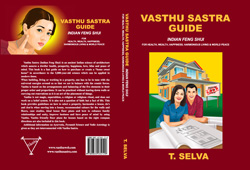
Vashtu Sastra Guide
By T. Selva
ISBN: 983-41341-2-6
Publisher: Master Yuvaraj Sowma
Format: Paperback
304 Pages
Price: RM35.00
Website: www.vasthuweb.com
Vasthu Sastra Guide is a non-fiction piece of work. In the author’s own words:
‘Although the awareness of Vasthu Sastra is increasing daily worldwide, I found that many people lacked understanding of the effective application of Vasthu Sastra rules on their properties. This prompted me to write this book to enhance the understanding of Vasthu Sastra. My purpose in writing this book is to share my discoveries and knowledge of this science with people interested in harmony and peace of mind.’
The topic in question is Vasthu Sastra and for those who do not know what it is the author has provided a simple definition of this term – ‘vasthu’ means a habitat and ‘sastra’ means science. Indeed, Mr. Selva states, ‘Vasthu is not magic, superstition, a religion or religious ritual, and does not work on a belief system. It is also not a question of faith but a fact of life.’
The book focuses on the steps a householder should take to ensure that he is living in a Vasthu Compliant house. It is possible to pick up this book, skip the first few chapters and hone in on the detailed explanation of where things should be placed within a dwelling place. However, this is to do disservice to the text proper for Mr. Selva has taken steps to provide a brief explanation of the origin of this ancient science, the application and effectiveness of Vasthu Sastra, some fundamental principles. These initial explanations provide a basis of understanding much of the remainder of the text. For instance, Mr. Selva says: ‘When an individual creates a home, he or she is creating a micro universe that entails all aspects, influences and elements of the universe.’
Mr. Selva proceeds to give a detailed analysis of how to choose a piece of land, checklists for what to observe and be cautious about when choosing this land, how to construct the house proper and what to do if the property is already built up. It is not merely the external area of a property that is discussed but the internal portions of each quadrant of a home, like the master bedroom, the kitchen and the study area, is also investigated. If you live in an apartment, there is a specific chapter on how to make this micro universe you call home Vasthu Sastra compliant. Of particular enjoyment are the case studies which all showcase stories of people’s whose lives have changed when they began to practice Vasthu Sastra principles.
In all, the most appealing thing about the entire book is that it is filled with graphics; this means that even when a reader is hard-pressed to read each and every word in this book, it is possible to absorb the wealth of knowledge by just looking at all of the pictures.
Mr. Selva’s training in journalism comes through as the words he uses to describe the complex theories and ideas are simple to comprehend. More often than not, books in this genre are written in a style so complex that one just casts the books aside. With Vasthu Sastra Guide, it is quite possible to complete reading the entire book in a very short space of time.
The single criticism of this book is the fact that it has a subtitle, ‘Indian Feng Shui’. Imagine if Feng Shui is described as the ‘Chinese Vasthu Sastra’? There would probably be uproar of sorts. Clearly, at this moment in time, using this subtitle of ‘Indian Feng Shui’ is a necessary marketing strategy as Vasthu Sastra is a new field in the Malaysian context and people are unlikely to understand what it means. Still, it does not bode well and one can only look forward to the time when the use of such a subtitle will be unnecessary. Therefore, the chapter that explains the differences which exist between Vasthu Sastra and Feng Shui is very much welcomed and the sentences which jump out at a reader are these: ‘Vasthu Sastra can be practiced without demolishing or renovating your walls. … As to which one of the sciences to follow, my advice is try both and find out which one works for you better or observe Vasthu Sastra and Feng Shui by incorporating both practices.’
The book is a reasonable size and the paper used is of good quality. It is clear that care has been taken to showcase appropriate, colourful and beautiful artwork. All of these specifications denote a book of excellent quality. And yet, the most baffling thing about it is that the book is priced at a mere RM35.00. Then again, when the hope of the author is ‘that this book reaches every home in the world and brings happiness, joy, wealth, harmony and improved health to every human being on this planet …’ is not surprising that this book has been this reasonably priced.
Without a doubt, this is a highly recommended book and can be purchased online at www.vasthuweb.com.
Page 11 of 14