



Transform ordinary stories into extraordinary ones with our proven 7-step method. Join thousands of storytellers on their journey to mastery.

 Introduction: When we were working with our publishers prior to the publication of Snapshots!, I referred to the contents of an article Jennifer wrote (she mentions it in the text of the interview). I found it helpful and have, since then, used it even in my newsletter,Great StoryTelling Network. I had sent Jennifer a request as I wanted to interview here. However, as there was no response, I did not pursue the matter. I was, therefore, delighted to receive an email from her requesting an interview. I have great pleasure in introducing to you, Jennifer Hollowell ...
Aneeta: Jennifer, thank you for contacting me and requesting an interview.
Jennifer: You’re very welcome! I had noticed quite some time ago that you had featured my article, The Importance of a Pre-Publication Marketing Plan, and I’ve been meaning to get a “thank you” to you ever since. Then I noticed an interview with Kristen Fischer, an author I had worked with on her book, Creatively Self-Employed, and I thought while I’m at it, why not see about an interview? I’m a firm believer in not letting any doors close that open before you voluntarily.
Aneeta: First, please tell me a little about you. Where were you born and brought up; what’s your family like and where do you live now?
Jennifer: I was born in Massachusetts, but I was brought up in Maine. I moved out on my own when I was seventeen and a junior in high school and never looked back. Over the years, my experiences have landed me in New Jersey, New Mexico, Oregon, California, New York and then back to Maine. Now, I live in a very quiet town in Maine and am raising three beautiful children (ages five, six and seven) with my boyfriend. (two children are mine and one is his)
Aneeta: When did you decide that you’d like to become a writer and why?
Jennifer: It was my senior year in high school, about a month before graduation, when the feeling overwhelmed me. I had written daily for as long as I could remember (journal entries by the 100’s, poetry, short stories, personal research about family matters), so it seemed very natural. I had a conversation about this with my English teacher and his response squelched that dream. It went like this:
“So, what do you plan on doing with your life anyway? I mean after school with college or work or whatever.”
“I’m going to be a writer.” I couldn’t help smiling when I said those words. It was the first time in a long time I was talking about something that truly made me happy.
He started laughing uncontrollably, to the point of tears in his eyes, before finally saying, “you’ll never be a writer.”
Those words stung. They motivated me, though. I had a drive, I had to prove him wrong, I had to prove to myself that he was wrong. Six years later, when I was pregnant with my first son, I started building my career. I was in a high risk preganancy and had to be taken out of my current job (assistant manager at a book store), but I couldn’t *not* work. So, I wrote.
Aneeta: I understand you’re a freelance writer. Is there any special genre you specialise in?
Jennifer: The bulk of my work centers around how-to art projects, projects for children, parenting, book reviews, home decorating and pieces about how to handle life changes.
Aneeta: Can you please share one of your pieces with us here?
Jennifer: Yes, here’s a link to my latest suite101.com article about how to work your way up the scale from a small canvas to a larger one
Aneeta: I understand you were interviewed by Kristen Fischer for her book Creatively Self-Employed. What was that experience like and if permissible, can you share a little of what you said to her?
Jennifer: Kristen is a pleasure to work with. She and I started communicating regularly in 2003, when we met through an art group (www.nervousness.org) and later learned we both spent time at the absolutewrite.com forums. She expressed her interest in building a business as a writer and, to me, she was already there. Her experiences in life, other employment situations and her education provided the perfect buidling blocks . . . all she had to do was take that step.
During that process, her book idea was born and she approached several of us to be interviewed. I was honored and immediatly replied with answers to her questions. She asked questions about our fields of expertise, our experiences and how we dealt with challenges. Our responses are meant to inspire others to take that important step toward achieving their goals and dreams.
Aneeta: I understand, also, that you’re an artist. Can you explain this a little further, please?
Jennifer: Art and writing have always gone hand and hand for me. When I wasn’t writing, I was drawing or painting. In 2003, I was exposed to numerous other art practices (mail art, art journals, altered books, etc.) that soon became my new “art addiction.”
I started selling various art pieces online in 2004 on ebay, myspace.com and on communities I found through livejournal.com. I have things on etsy.com, too, but it’s still an experiment because I don’t know a lot about that site. The types of pieces I create for sale are paintings, hadmade books, altered books, altered objects and ACEOs. You can see it all here:
http://www.artist_writer.butterflygrace.net
http://www.etsy.com/shop.php?user_id=12921
http://myworld.ebay.com/artist_writer_2007
I’ve also started publishing my art journals on a monthly basis through lulu.com:
Explorations: January’s Art Journal lulu.com (the exact link is unavailable at the time of this writing because the site is undergoing maintenance.
Aneeta: As you may know, this website caters for storytellers. What advice do you have for people who are venturing into this field?
Jennifer: Don’t let negative people stifle you. This happened to me and, to this day, I have difficulty looking at myself seriously as any kind of writer. I started out with a fiction manuscript, several short stories and nearly 200 poems. Because I let the negative influence me more than the positive, I can’t bring myself to do anything with any of this material (what I didn’t throw away, that is). Don’t follow this path.
Aneeta: Jennifer, this is all I have to ask. Is there anything else you’d like to add?
Jennifer: I want to thank you for this opportunity to talk with you about my career. There’s been a lot of hurdles to jump over the years (heart surgery in 2004, another heart surgery in 2005 and a battle with cancer in 2006) and I’ve spent the last several months picking myself up, dusting myself off and getting back on track. Conversations like the one you and I just had will keep me heading down that path.
Aneeta: Jennifer, thank you.
Jennifer: thank you!
This piece may NOT be freely reprinted. Please contact editor @ howtotellagreatstory.com for reprint rights.
Click here to return to the index of interviews on 'Blow Your Own Trumpet!'
 Introduction: As a writer and storyteller, many times, I interview and am asked to interview writers. However, it is my belief that storytelling is something that permeates every facet of life. Therefore, when the chance came to interview a person who told her stories in the work she created, I jumped at the chance. I have great pleasure in introducing to you, Penny Halgren ...
Aneeta: Penny, thank you for agreeing to this interview
Penny: Thank you for asking. It’s always a pleasure to connect with people from other parts of our globe and find out how much we have in common.
Aneeta: Let’s start with something about you. Tell me about where you grew up, your family background and where you live now.
Penny: Los Angeles, California was my stomping ground as I grew up. After graduating from high school, I attended the University of Southern California and graduated with an MBA in Finance and Business Economics. My work experience includes 10 years in the technology industry – way back in the early 70s when Honeywell and IBM were deciding whether to enter the desktop computer market. I remember top management at Honeywell where I was Manager of Planning and Analysis coming to the conclusion that nobody would want a small computer. Guess they were wrong.
Anyway, I spent 3 years in Massachusetts, and then decided to return home to Southern California. Two years later, I got married, moved to San Diego, and had a baby. Fortunately we were in a position for me to stay home a raise our children. That was when I began quilting.
Aneeta: I know of your work because of your site, http://www.how-to-quilt.com. Tell me a little about how you came to have a website on quilting.
Penny: When I was pregnant with my first child, my mother-in-law told me that she would buy a quilt for my baby once I found one I wanted. Prior to that, a quilt wasn’t even in my vocabulary. Certainly I had seen many blankets, but I didn’t know the difference between a blanket, a bedspread and a quilt. Although I searched for months for a baby quilt, I never found a one I liked, so I decided to make one; and I haven’t stopped making them.
Once both of my children were off to college, I decided to share my love of quilting with beginning quilters and turn that passion into a business.
I looked around at the resources for beginning quilters, and remembered how difficult it was for me as a beginner in the early 80s. I was very lucky here in La Mesa, the tiny town I live in, that there was a real quilt shop, with hundreds of bolts of 100% cotton fabric and a mother-daughter team who were passionate about quilting. Even so, the “take-home” resources for beginners were pretty poor. My learning came from workshops and wasted fabric (trial, error, and throwing mistakes away).
I decided that what beginner quilters needed was a step-by-step guide that would walk them through one quilt, from start to finish, sharing all of the tips and tricks along the way. Once they finished that simple quilt, they would have a solid foundation for their quilting journey.
Aneeta: I can now see that there are off-shoots to this site in that you’ve got two other sites, http://www.Rag-Quilt-Instructions.com and http://www.Fabric-Postcards.com . What do these new website focus on?
Penny: Once my first book, The Beginner’s Guide to Quilting, Vol. I, was finished and the website was up and running, I noticed that there were a lot of people interested in rag quilts. Using the same idea, I wrote a step-by-step guide for making a simple rag quilt. Several months after that book was complete and the site was online, I added the “Red Hat Supplement” to interest ladies in the Red Hat Society.
Then, in paging through quilting magazines and surfing the internet, I found that folks were interested in fabric postcards. So, I created resources for beginning quilters to make fabric postcards. The first fabric postcard book is a step-by-step guide for transferring photos onto fabric, postcard size. This book has been very popular, since using fabric photos is becoming very common now.
In addition, last May, I decided to begin a fabric postcard project where quilters can make fabric postcards to be sent to the troops in the Middle East. This has been quite a popular project, and has now expanded into Canada, to support Canadian troops in Afghanistan. To date, we have shipped more than 1,535 fabric postcards, all hand made by quilters, their family and friends, and children in local schools.
Aneeta: I’m curious about something. Years ago, I made a card using some left over fabric. My intention was to use it as a postcard. However, when the time came to post it, I was told to put it in an envelope as it did not qualify as a postcard – apparently, postcards had to be absolutely flat and preferably, printed. With your Fabric Postcards, do you face such a problem and if so, how do you overcome it?
Penny: When I finished my first fabric postcard, I was afraid that the post office would make me put it in an envelope. However, online, I saw pictures of fabric postcards that had been sent through the mail, since they had stamps and post office cancellations on them. So, I was somewhat encouraged. I read the post office regulations, which indicated that postcards could include non-traditional forms.
Then I took my fabric postcard to the local post office and told them I wanted to mail it. The clerk suggested that I put first class postage on it, even though I was well within the requirements for postcard rate. She said that post office workers were more likely to treat it well.
Since then, I have read that if you have buttons, ribbons, or other embellishments on your card, it’s best to put it in an envelope, since those things might fall off or be damaged.
I have heard of companies sending coconuts through the mail. Imagine, bare coconuts! They are addressed, and have first class postage on them. How the postage sticks to the coconut is beyond me. But I think that if the post office is willing to deliver a coconut not in a box, once it gets past the clerk at the desk, a fabric post card should be easy.
Aneeta: I’ve read your many newsletters and it’s obvious to me that quilting and storytelling are somehow inter-related. Am I right in saying this? If so, can you please share 3 stories about the quilts you’ve made – whether they be stories about the process of making quilts or the stories within the quilts themselves.
Penny: I think everyone remembers their first quilt – whether it is a pleasant experience or not!

Story 1
My first quilt came about because my mother-in-law said she would buy a quilt for my new baby.
I knew nothing about quilts. I liked the idea, so I started looking around for one. After a few weeks, I gave up and decided to make one.
Probably because I was unfamiliar with quilting, the thought of a patchwork quilt didn’t really appeal to me, so I chose a pattern that was a barnyard scene. Mothers and babies seemed like a good theme for a new baby human.
The quilt ended up being quite an undertaking, especially since I had never done appliqué or quilting. Fortunately I had a friend who was an excellent quiltmaker, and she was more than willing to help me with the project.
The baby was born long before the quilt was finished, and I spent many hours watching my newborn and making this quilt. The was on her bed until she was about 10 years old and decided that she wanted something a little more feminine.
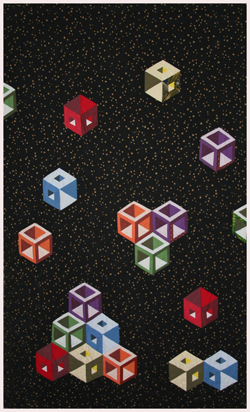
Story 2
Many years after I began quilting, I became interested in how shades of fabric create three dimensional affects.
One of the books that I used as a resource included a pattern for a wall hanging with the 3-dimensional boxes you see in the quilt pictured on the left.
My original plan was to duplicate the quilt pictured in the book. However, my first departure was to make 3 of each of the blocks, instead of the 1 called for in the pattern.
Once all of the boxes were done, I looked at the background on the quilt in the book. It was made up of about a billion little triangles, and looked like it would be no fun to put together, so I decided to design my own background.
As I looked at all of these 3D boxes laid out on my design flannel, somehow they looked like boxes floating in space. Tucked away in my fabric stash was a piece of black fabric that had gold stars sprinkled on it. Perfect!
The boxes were placed in groups on the black fabric, and then I set about sewing them – first to each other, and then to the background.
Even though I had done several appliqué quilts, for some interesting reason, I decided that it would be better to cut the background fabric and then sew the boxes into holes. That was a mistake….I spent hours getting the corners square, and some of them aren’t right, but at least it was done. Years later I still wonder why I didn’t just appliqué the blocks onto the background.
For the quilting, the original plan was to quilt a sun in the top center, and simply quilt straight lines, or sunrays, at angles down the quilt. Easy. The quilt was finished, binding was applied, and it was hung on the wall.
Later that day, I noticed that there were huge gaps of fabric hanging out and away from the batting – looking pretty bad. That was when I discovered that fabric by itself has no real structure, that it’s the seams that make the quilt top hang straight. And this quilt had very few seams. The only solution was to do more quilting.
So I filled in the spaces with quilting stitches outlining spaceships, planets, stars, and other things that relate to space – including some images from StarTrek.
Story 3
One of the stories I tell on my website is of my daughter when she wanted to learn how to make a quilt, and how she didn’t want to learn from me. So I taught her sewing teacher how to quilt, so the sewing teacher could teach Stephanie.
Given that as a background, you can imagine how pleased I was that Stephanie has continued to quilt, and has designed and made some really fun and interesting quilts herself.
When Stephanie was in college, we decided to go on a quilting retreat together. She signed up for classes that interested her, and I signed up for some that I thought would be fun.
One of the classes she signed up for was a 2 day workshop, and the teacher was very critical of everything Stephanie was doing. Needless to say, she was not looking forward to going back for a second day.
The teacher of the workshop I had registered for the second day seemed like a great gal, and I asked her if Stephanie could join our class. She agreed, on the condition that we would work on the same quilt.
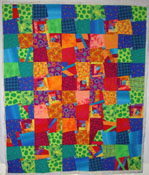
That night, we looked at the class materials list and our fabric stack and came up with a fabric pile that was fun and very different from what I had planned. In class, we arranged ourselves as a kind of assembly line – I cut, she sewed – so by the end of the day, our quilt top was almost finished.
She went back to college; I was tasked with finishing the quilt. And now, 4 years later, the quilt is almost fully quilted. Any year now, it will be complete!
Aneeta: There are, obviously, many kinds of stories with specific themes – fairy tales, adventure tales, romance, horror stories and so on. When you first make a quilt, how to pick such a theme?
Penny: It’s interesting that you ask that question. I have never really thought about the correlation, but in many of my quilts, there is. The 3 dimensional blocks above took on a science fiction/space theme. I think the theme kind of evolves as I make the quilt.
Generally I find a block pattern or design which appeals to me for some (usually unknown) reason. Then I start looking at color and fabric, and a theme comes from there. Another good example is the quilt Stephanie and I made together. It started out as a collection of fun, bright, somewhat bizarre fabrics. We had no idea what the design would be, we just picked a stack of fabric.
As the quilt was made, it ended up turning into a kind of circus, party themed quilt.
When I make a quilt for a specific individual and occasion, I take into consideration the occasion and the personality of the person.
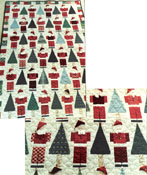
One year, I made a Christmas quilt for a friend. She was a very precise, exacting person, and I chose a Santa Claus pattern that had Santas and trees all lined up, but they had fringed beards and actual bells on their hats.
The picture on the left is the full quilt, with a close up of the Santas and trees.
Another quilt I made (shown on the right) was for a new baby who was born with cystic fibrosis. Her mom was Stephanie’s 5th grade teacher. Stephanie picked the design from a Thank You card, because we were all very thankful that the baby survived and came home from the hospital relatively healthy.
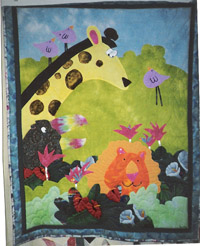
This quilt is still probably one of my favorite quilts. I’m not sure whether it’s because of the quilt itself or the memory of the success and the health of the baby (who is now in high school).
Aneeta: You’ve probably heard this a thousand times before and I’m sorry my question might come across as being trite but, I’ve wanted to ask this from the moment I first came across your site. When I read about your work, one of the things that popped into my mind was that movie, How to Make An American Quilt. Do you have a quilting group and indeed, are they very much like the characters in the movie?
Penny: When my kids were in elementary school, four of us moms got together once a week for an evening of quilting. The talk was about school, teachers, kids and husbands. Although it wasn’t quite as interesting or dramatic as How to Make An American Quilt, the discussions about family, friends and what was going on in the community was fairly similar. Although I have to say, we didn’t get into some of the more intimate details they got into in the movie.
Aneeta: As you know my site caters for storytellers. Do you have any advice for them?
Penny: The advice I have is “Tell your story.” I used to think that my collection of stories was boring and meaningless. As my parents have gotten older, my kids and I have pulled stories out from them, and I am finding them fascinating and a real insight into them and their trials and successes.
What I have come to realize is that usually what we find boring, others find interesting or helpful. Helpful in that we begin to realize that there are a lot of people thinking the same things and going through the same things. Knowing that has given me courage to do a variety of different things with the thought that “if they can do it, so can I.”
Aneeta: Penny, this is all I have to ask. Is there anything you’d like to add?
Penny: Your website is wonderful, and an excellent place for people to learn how to jump-start their storytelling skills. And thank you for giving me an opportunity to tell mine.
Aneeta: You are most welcome.
This piece may NOT be freely reprinted. Please contact editor @ howtotellagreatstory.com for reprint rights.
Click here to return to the index of interviews on 'Blow Your Own Trumpet!'
 Introduction: In the last edition of my newsletter, I asked if anyone wanted to be interviewed. Frankie Lennon responded to this requesting an interview. It has been an interesting interview and without further ado, I have great pleasure in introducing to you Frankie Lennon ...
Aneeta: Frankie, thank you for agreeing to this interview
Frankie: Thank you for asking.
Aneeta: Let’s start with something about you. Tell me about where you grew up, your family background and where you live now.
Frankie: I am a creative woman writes, teaches, gardens, designs and makes jewelry. Born in Knoxville, Tennessee, I graduated from Austin High School; then I went to college at Indiana University where she received a B.A. in English and an M.A. in Creative Writing. I have done a number of things to keep a roof over her head, including advertising copywriting, public relations, training facilitator, HIV Health Education program management for Minority AIDS Project, teaching traditional college English composition and literature, and teaching socio-cultural issues in Weekend College for Sociology. At present, I teach in Los Angeles at Mount St. Mary’s College and at Los Angeles Trade Technical Community College. I am a 2005 recipient of the highly competitive Hedgebrook Writers Residency for Women. My other accomplishments include being named Faculty of the Year at Mt. St. Mary’s College, inclusion in the 9th Edition of Who’s Who Among America’s Teachers, and a cherished award from Minority AIDS Project for Outstanding Continuous Service. I am also the Founder and facilitator of Talking Drum Creative Writing Workshop, which is open to the public, and a member of the Soulful Salon, a sexually diverse gathering of artists of color in Los Angeles. I am a working writer who makes sure I nurture her artist within. Among my previous writing credits, I count my stints as a newsletter graphic designer and editor, brochure design and copywriting, feature articles for magazines and newspapers, training manuals, and two soft cover books.
Aneeta: Now let’s proceed to the core of this interview which is your desire to tell my subscribers about your new book, The Mee St. Chronicles: Straight Up Stories of a Black Woman’s Life.
Frankie: The Mee St. Chronicles is a very candid, passionate memoir of my battle to claim my own life and sexual identity. In it, I narrate stories starting with my childhood and take you with me on my turbulent life journey & struggle to find freedom from the many prisons that bind me. How the conflicts in my life play out give my stories page-turning drama that I think readers will enjoy.
Aneeta: How did the book come about?
Frankie: The idea of writing about my life experiences had been at the back of my mind for years. It took my old friend, Nikki Giovanni, to act as catalyst for this. She had planned to edit a book of stories and essays and she asked me to contribute. I did by writing a piece called “The Code.” Although the book never came to fruition, that story ultimately launched me into writing the stories of The Mee St. Chronicles.
Aneeta: How is your book like or different from other memoirs?
Frankie: Well, mine is about my battle to claim my life and my sexual identity. The fact is, “out” Black Lesbians are not crowding the field to write about their struggle to claim their lives with integrity in a world that often appears very homophobic. Of course, there’s Audre Lourde who wrote Zami years ago. And Alice Walker has written a short story or two about living in the life. My book is a different kind of memoir. I put myself out there on several fronts, including my battle with alcoholism. I tell it like it is.
Aneeta: Why should people buy your book? What does your book offer the reader?
Frankie: They should buy because I tell powerful stories, exciting stories, stories that make you think and re-evaluate some issues. They should buy it because I offer the reader the chance to see and experience my naked feelings, conflicts, fears, and struggles. I get down to the nitty-gritty in The Mee St. Chronicles, and you get the chance to experience my trials and tribulations along with me. It will be exciting, funny, and heartbreaking. And it will never be dull.
Aneeta: Who are you targeting as readers?
Frankie: There’s something for everybody—young and old, Straight & Gay, Black, Latina, White, people fighting addictions, people with the virus, people who know or don’t know about living Jim Crow in the South. My stories are stories about finding out who you are, about trying to make sense of your life, about learning how to get rid of the shame that binds you.
Aneeta: What have you learned about yourself as a result of writing this book?
Frankie: I’ve learned that understanding who I am and finally not being ashamed of that was worth all the struggle. And I’ve learned that I really am a good writer whose work people like very much.
Aneeta: What inspired you to write this book? Why did you take the time and effort to write it not knowing whether you’d be published or not?
Frankie: First, the act of creating pushed me forward. Writing quenched a lifelong thirst and filled a void because I began to honor and express the creative spirit within. Second, I wanted to preserve my memories by telling my stories. Memories are all about identity for me. And telling you who I am, through my memory stories, set me free. No more secrets to poison my spirit. And third, I thought that my stories might help to set many people free. Or at least put their feet on the road to freedom. Especially those who feel different and think they are cursed by that difference. These stories are to reassure them that they aren’t cursed. To encourage them to keep going no matter how bad things look or what others may say or do. To tell them they aren’t alone, that there’s somebody else who’s survived choosing the wrong road more than once, who’s fallen off the road several times, who’s lost the road completely, but who, in the end, has finally found her way.
Aneeta: What has been the greatest delight in your writing career so far?
Frankie: Getting The Mee Street Chronicles written and published.
Aneeta: What writers have inspired you?
Frankie: James Baldwin, Nikki Giovanni, Judith Ortiz Cofer, bell hooks, Stephen King.
Aneeta: Who has been the greatest influence in your life?
Frankie: My pastor and friend, Archbishop Carl Bean. His work in and out of the pulpit continues to leave its mark on me.
Aneeta: Where is your book available?
Frankie: You can read excerpts from my blog http://www.myspace.com/maryestelle and you can buy it from www.Kerlak.com or at Amazon.com
Aneeta: What advice would you give to aspiring writers?
Frankie:Keep writing. Make time to write no matter what. Don’t give it up and don’t let anything or anybody stop you.
Aneeta: Frankie, thank you
Frankie: You’re welcome.
This piece may NOT be freely reprinted. Please contact editor @ howtotellagreatstory.com for reprint rights. Click here to return to the index of interviews on 'Blow Your Own Trumpet!'
 Introduction: Dr. Neill Neill introduced me to Bill Wardell and his latest book, “Don’t Take Candy From Strangers” What Parents Need to Know about MySpace; I was impressed by what he wrote and decided to ask if Bill would be willing to be interviewed for this site. He agreed and it has been most informative. For those of you with children who are on the computer lots, don't miss the stories Bill tells in this interview. I have great pleasure in introducing to you Bill Wardell ...
Aneeta: Bill, thank you for agreeing to this interview.
Bill: The pleasure is all mine, Aneeta. I love the idea of the Internet and how it’s bringing the world closer together. We are all just a click or two away from meeting new friends, just like you and I did through our mutual friend, Dr. Neill Neill.
Aneeta: Let’s start with a little about you. Tell me the story of your youth, where you grew up, what you do for a living and so on.
Bill: I have lived in Utah my entire life, Midway, UT, USA as a matter of fact. We just moved about 5 miles away from where I had lived for almost 40 years. The move has changed me considerably, in a lot of good ways and especially with the changes in my online business. I have had a lot of great things happen over the last few months… I have a great life. I am married with 3 wonderful kids. Two of our children have special needs, and more now than ever, I realize how important it is to spend time with your children when they are young.
Being an online entrepreneur has and will allow me to spend more time doing what I love the most, being with my family. When I have spare time I really enjoy surfing the Internet and finding new sites and ideas. I also really like reading, watching sports and going to play a round of golf or bowling. When I have a little extra money, I really like eating in a nice restaurant with friends or family and especially my wife Anissa.
My grandmother raised me from the time I was 3 years old. She was a wonderful lady and she taught me how to be a good person. In a nutshell… it’s one of the most valuable lessons that I learned from my grandmother. She would tell me often, and I can still hear her say: Bill you have to be a friend, to have a friend!
My grandmother not only “talked the talk” she “walked the walk”. She was also my mother and my best friend. I have greatly missed her since her death but carry her words of wisdom with me, and try to teach my children the same teachings. Her advice has served me well through my lifetime, Thank you, Grandma!
My professional background includes many different industries, studies and education. In the past 25 + years I have had several years experience in the manufacturing industry. I owned a Heating and A/C Service company, worked in construction, worked with building contractors, I have experience in the flat printing and publishing world as a print broker, retail sales and manufacturing, and of course the most important experience for the last 6 years is my online marketing and content publishing business. One the best business decisions I have made over the last year or so was to participate in a coaching program with the group at Authority Site Center. They did a wonderful job of coaching and mentoring all of the ASC-Elite members. But, more than that I can tell you how much I appreciate the partners of ASC honesty and integrity in everything they do.
For the first time in a long time, I believe I will make my big dream come true, and I want to thank them for helping that dream come true in advance.
Let me explain it like this, I was 30 years old and going nowhere fast…
I had gone to college and received a 2-year degree in HVAC, and worked for a heating company for about 4 years, and was in a major RUT, when a friend of mine introduced me to the world of Amway and network marketing. For a lot of reasons this was a real eye opener, and for a lot of different reasons. I was a kid that had lived in a small town my whole life. I didn’t even know what a real motor home looked like on the inside, let alone thinking about what a Motor Coach was.
That’s where the story started… let me tell you where it finished. The fact was I was 30 years old and didn’t know that a very simple fact of life was, that the books you read change your life! Especially a book like, “Think and Grow Rich”. And, that the people you associate with shape who you are, and also help you to determine how successful you are going to be… I know everybody has an opinion about Amway, just like politics, and religion, that’s a given. But, what I got out of that experience was that I learned how to dream about what I could have and what I could do for others, and it really did make a difference to them. Even, I did not see the results at the time I was in Amway.
What does this have to do with their program, well it’s like this: it’s the one dream I have never let go of. For the past 15 years, I have wanted to create a home schooling system that would allow for a student no matter what his/her background to have a place to build their dreams. I learned in the early ‘90s and through my studies that by reading books and using study guides the training would fulfill my dreams and would do the same for others. It would be a dream university, rather than going to school get an education just to get a good job type of system. Now, all these years later, I really know that it’s possible, because money is just an obstacle. The dream is what makes everything possible! When I started building an online business I had these big dreams to BAnetMillionaire and then I would have enough money to start my dream project. Six years later, we are so much closer, and the reality of this happening becomes more real each and everyday. In the last couple of months we have seen tremendous growth, especially with the many things that have happened to OSA and the increase of hits coming in everyday, it’s so awesome!
I know that I get very wordy when I try and tell others what’s in my heart, but, I know this, I owe a very special thanks to Jack Humphrey, Mark Braunstein and Peter Lenkefi at ASC for all they have done for me and our Online Security Authority website and business! And, more than that is what they have done over the last 6-12 months for me, and the potential of what they have helped me create for the next 5 years. I’ve lived this thought for the past 15 years Badreamer and you will BAnetMillionaire and now I say, “The value I place on my self is the value others will see in me!” That is what’s really going to make my dreams come true.
Aneeta: I know that you have started this Online Security Authority Network. Tell me all about it.
Bill: The story goes like this: I started the ASC coaching program and I had about 5 or 6 really good ideas to start a website with. My coach and mentor Mark, guided me through the research process and together, what we had found was that I had a real passion about the online security niche. In creating my site and researching and writing articles I found a smaller sub-niche that I have been able to become very passionate about. This sub-niche is online predators, and the growing problems parents are facing with websites like MySpace and other similar sites who are allowing the predators and pedophiles access to children!
As a parent of young children, I have found that there is a real need for parents to be able to find good information and help online, for this and other security issues. Everything we have done over the last year has become our passion, and our life, as far as an Internet business is concerned. We wrote our ebook as a help and guide! After the success of the ebook we developed the OSA Network, which is a combination of many aspects of our niche. We wanted a place that parents could get together to share ideas and thoughts about online security and the dangers they were dealing with their children! We are now doing a weekly online OSA Live Radio Show as a help and an extension of our online forum, where parents can get answers to their questions and problems. Things have changed big time!
Aneeta: On the forum, I see one part entitled ‘Horror Stories’. Do give me an example of a horror story that has ‘stuck’ in your memory, please.
Bill: Last year we were on a family vacation and one day we were traveling on Santa Monica Blvd., when I noticed a billboard off in the distance. I could see digital numbers turning over like 3,738,983 then 3,738,984 then 3,738,985 and 3,738,986… when I got close enough to see the words, I could see that they said: One more person has just died from cigarettes and/or a smoking related illness. I just had one of those ah – ha moments. I had been researching my ebook for awhile and it just hit me that this is a real person that just died, in fact there where 4 people that had died while I was traveling towards the billboard and each one of the numbers were someone’s brother, father, husband, or friend, and it really hit home. Our ebook has a similar premise when it comes to how the world judges a predator and pedophile. “It’s just one more child.” They are adding one more notch in their bedposts and one more child that society has added to the statistic pool. This is very un-settling to say the least, because this child is someone’s daughter, sister, or friend. This fact has stayed with me and haunted me. Ever since that moment of realization it has been my mission to bring this message to parents everywhere. I can still remember the feeling of seeing that billboard image, even though it was just for a few seconds on a sunny California day!!!
As of late, there have been several young girls who have been abused by pedophiles, and their parents have sued MySpace and other social networking sites. I believe the real horror here is that parents have not understood that there is a real need for them to be Very involved in their children’s online usage. Children know more about computers and the Internet than most of us parents do, but that is not an excuse to not know more or to be more involved in how and where our children are going online. Don’t allow them to be the next statistic in a horror story.
Aneeta: I know you’ve got a book entitled “Don’t Take Candy From Strangers” What Parents Need to Know about MySpace that you’re giving out for free. Please explain what it’s about and why you wrote it.
Bill: My original intent was to sell the ebook, but, I found there was a real message that needs to get out to the parents of the world. We want to work with the local PTA’s and the national PTA along with other parent organizations to promote the ebook! All we are asking in return is for all who find this book useful and helpful, to please continue to promote it to your family and friends. Also, join and support our cause at OSA Network and listen and participate with our OSA Live Radio Show.
This book has a great story behind it, and its history and usefulness, since it became available for purchase has grown. Everyday, we become more and more aware of the timeliness of this book, and the growing need for parents to be more informed in order to help their teens. In today’s world, we need to have every tool available to help protect our families and ourselves.
My goal is by 2007 – 2008 is to have this ebook in Millions of parent’s hands, to be able to start the new school year off right! The problem of Internet predators and pedophiles is not going away, and until we start punishing them for their crimes, and for that matter all cyber criminals everywhere need to do the time if they are doing the crime. I truly believe that Internet crimes are premeditated and need to be prosecuted and punished to the full extent of the law.
Aneeta: Would you like to share the link here?

Bill: 99.9% of the content and services provided on these 3 sites are Free to our visitors. And will always remain this way for as long as we have parents who need guidance.
http://www.onlinesecurityauthority.com/
http://onlinesecurityauthority.net/
http://www.blogtalkradio.com/OnlineSecurityAuthority
There is also a very special document here, it’s called an Online Security Agreement:
http://onlinesecurityauthority.com/Your/Online-Security-Agreement.pdf
Aneeta: As you know, this website caters for storytellers. I know that this might not particularly tie in with what you’re doing but nevertheless, what role, do you feel, storytelling has in your line of work?
Bill: I think the Internet has a story to tell, and the Online Security issue of the day, is no different. Also, the news stations, blogs, parents and teens are telling stories online everyday. There are a lot of great things happening online, but there are a lot of things that are happening that are not good. As a society we need to look at predators and pedophiles as the professionals they really are; “Professional Sexual Stalkers” and their years of training and honing their craft makes them almost un-stoppable if they decide they want your child! There is no way a parent or a young child can stop a predator unless they are prepared and they have been communicating with each other.
We want OSA to be a place where you can turn to for information on how to protect yourself and your family. We tell stories everyday of security issues that are either improving or that are being misused, and in order to stay ahead of those who are misguiding or who are misusing the Internet, we need to be able to find the resources to combat them. We want to hear your stories and suggestions or thoughts. We are one big family, and we hope to be able to help save the innocence and lives of children everywhere.
Aneeta: Bill, this is all I have to ask. Is there anything you’d like to add?
Bill: Thank you, Aneeta especially for agreeing to promote our cause and our ebook to all your members. This is a special book and it needs to be in every parents hands. They need to read it and learn what their children are doing online, and also use it as a tool to open the lines of communication between themselves and their children. Every problem can be solved with the right approach, and communication is a great way to let our children understand that we really do care about their safety.
Again a great place to start open communication is the Online Security Agreement.
Aneeta: Thank you, Bill.
Bill: Thank you, very much Aneeta.
This piece may NOT be freely reprinted. Please contact editor @ howtotellagreatstory.com for reprint rights.
Click here to return to the index of interviews on 'Blow Your Own Trumpet!'
 Introduction: I am a subscriber to Cheryl's newsletter, Writer to Writer. I was on the look out for people to interview and wondered if Cheryl would be interested. I asked. She agreed. so, without further ado, I have great pleasure in introducing to you Cheryl Wright ...
Aneeta: Cheryl, thank you for agreeing to this interview.
Cheryl: Thanks for asking me!
Aneeta: Cheryl, let’s start by getting to know you a little bit more. Where did you grow up and what kinds of jobs did you do? Also, where do you live and what’s it like there?
Cheryl: I was born in a little town called Bright, which is at the foot of Mount Buffalo in Australia. When I was three years old, my family moved to Melbourne, where I grew up, and still reside.
I live on the outskirts of Melbourne, which is not far enough out to be called country, but not exactly close to the city either. When I was growing up, this area was totally country, and it was a half-day trip to get here. These days, with the freeway, it takes around thirty minutes. Now that’s progress!
I’d love to move further out, into the ‘real’ country, but I have three young grandchildren live with me, and I don’t want to uproot them from their school. Maybe one day – when they’re older.
I’ve undertaken a variety of jobs throughout my life, including accounts manager, credit assistant, events organizer, shopping tour hostess, debt collector, secretary – both for a project manager, and later for the manager of the handbooks department of an international business. It wasn’t until I became quite ill with a lung disease – around five years ago – that I was able to fulfill my life-long dream of becoming a writer.
Aneeta: When did you start writing and what was it that made you want to be a writer?
Cheryl: I’ve always known I was born to be a writer, but tried to push the idea aside. When I was in grade six, my teacher went on long service leave. A hippy substitute teacher arrived. I wasn’t too sure about him and moved to the back of the class. After a few days he began reading poetry to us on a daily basis. This was the springboard for discussions about the history of the poets, and ultimately, Australian history. Down the track he also introduced short stories.
I’m convinced this teacher inspired my love of the written word.
And yes, I moved to the front of the class not long after he arrived!
Aneeta: I understand that you’re not only an author of several books, you’re also a contributor to a few others. Please choose three in each category and describe that work to us.
Cheryl: How do I choose? Okay, here are three of my own books:
Outside the Square Fiction Workshop – this is a compilation of my online award-winning workshops on fiction writing. This book was extremely popular when it was released, and still is today.
I Wanna Win! – Tips for Becoming an Award Winning Writer – the title of this book is quite deceiving. It was written for those people who want to enter and win writing contests, but it’s also a boon for those who need to hone their writing skills.
Writing for Profit: Break into Magazines – this is the latest of my ebooks to be released, and has been very popular from the moment it was available. I think that’s because it goes into absolute basics of magazine writing, and doesn’t assume the reader understands the terminology and concepts.
And here are books I’ve contributed to:
Writer Profits: How I Got the Gig, Volume I – 15 Writers Tell How They Get Paying Gigs and How You Can, Too
– this is the latest book I contributed to, and I’m extremely proud of that effort, particularly because my story is the lead in the book. (Yay!)
The book is a compilation of chapters from a variety of authors from around the world. It features stories of how each writer ‘won’ specific writing gigs. Mine uses networking and marketing as a basis, showing how each gig I gained came as a result of these important concepts.
Cancer: A personal challenge
– this book features stories from a variety of people, not all of them writers. My essay is about the death of my father eight years ago from lung cancer, and how it affected my entire family. Sadly, my mother died in December (2006) – also from lung cancer. All profits from this book – from my websites – goes to the Australian Lung Foundation. They are undertaking further research into this killer disease.
Book Marketing from A to Z
– this is another book that features my marketing expertise. Again, it’s a compilation from various writers around the world, but this one has short, quick tips.
Aneeta: Now, I know that you own and manage several website, namely,
http://www.romancewriter2writer.com
Would you care to explain the purpose and function of each of these websites, please?
Cheryl:
http://www.cheryl-wright.com is my author website, and features my books and other related work, such as editing, and gives an insight into me – the author.
www.write-essentials.com is my business writing website. It is there to showcase my copywriting, newsletter, and other business writing skills, and is aimed at small and medium sized businesses.
http://www.writer2writer.com is for writers who want to learn the craft, or improve the skills they already have. This is the site I needed when I started out. (Hence the reason it was started.)
http://www.romancewriter2writer.com is similar to Writer2Writer, but contains only information pertaining to writing romance.
http://www.aussieauthors.com is a place for Australian and New Zealand writers to promote themselves. Believe it or not, this is the only website that is dedicated to this purpose.
I am co-owner of this site. My writing buddy, Sarah Cook, is the other owner. The site was her idea and inspiration.
I have added another site to the list! This one is a paid membership site called www.Resources4Writers.com
The site contains books, courses, and software etc., that are relevant specifically to writers and internet marketers/entrepreneurs who want to make money from their writing. The site is very new, and has only recently opened its doors.
Aneeta: As you know, this website caters for storytellers. Would you care to share your thoughts on this art of storytelling with my subscribers, please?
Cheryl: When I was starting out I found it hard to write fiction. It took a very long time before I realised I was thinking too much when I wrote. Once I stopped thinking, my writing started flowing, and my work began to get published.
In my experience, the trick is to let your heart rule, not your brain.
Aneeta: Cheryl, this is all I have to ask. Is there anything you’d like to add?
Cheryl: Just one little tip. Writers need to constantly hone and update their skills. Some writers believe that once they’re published, they no longer need to educate themselves. That’s totally incorrect.
Even with all the publications I’ve had, I still take at least one class per year, and often two. They may not be directly related to writing, but usually they are connected in some way – like web design, for instance.
Aneeta: Thank you, Cheryl.
Cheryl: Again, thanks so much for the opportunity to talk with you. I hope this helps your subscribers in some way, and has inspired them to pursue their writing goals.
This piece may NOT be freely reprinted. Please contact editor @ howtotellagreatstory.com for reprint rights.
Click here to return to the index of interviews on 'Blow Your Own Trumpet!'
 Introduction: Sometime last month I received an email from Regina Kuan of the National Book Development Council of Singapore. Regina wanted to know if I'd be willing to interview some of the people scheduled to participate in the upcoming Singapore Storytelling Festival. I agreed and she put me in touch with Evelyn Clark. Without further ado, I have great pleasure in introducing to you Evelyn Clark ...
Aneeta: Evelyn, thank you for agreeing to this interview.
Evelyn: It’s my pleasure, Aneeta. Storytelling is my favorite subject!
Aneeta: Let’s start with a little information about you. Please share with us some stories of your life, thus far. For instance, where did you grow up, what jobs have you undertaken, where do you live and so on?
Evelyn: I was born and raised in the U.S. Midwest—in Springfield, Illinois, the state capital and home of Abraham Lincoln. My adopted home is the milder climate of the beautiful Pacific Northwest—the Seattle area, specifically—where I’ve lived for 40 years. I love outdoor activities, so to me this area, which is surrounded by mountains and water, is paradise! My favorite outdoor pastimes are hiking, boating, water and snow skiing, and traveling. Other interests include attending concerts and theatrical shows, getting involved in church activities, and entertaining friends.
I started my career as a news reporter. Since my early school years I’ve loved to write, and my first job was as a broadcast editor for the Associated Press. I loved it! It was a demanding job—and also a lot of fun.
Aneeta: What made you become interested in storytelling?
Evelyn: After my stint in news writing and editing, I transitioned into corporate public relations and began working “the other side of the desk,” helping organizations tell their stories more effectively. Then I launched my own consulting practice.
Eventually I realized that many leaders had lost touch with their own core values and weren’t communicating with their own employees. As a result, employees weren’t clear on the organization’s mission and how they could help achieve their goals. I got into this work to help companies be more efficient. This is about empowering leaders to reach for something more profound, more defined—and more measurable.
So in the early 1990s I developed the Corporate Storytelling® system and became a workshop and retreat facilitator and a keynote speaker. I work with executives and teams in the corporate world as well as the nonprofit and government arenas. I’m especially looking forward to participating in the Singapore Storytelling Festival and the Asian Storytelling Congress.
Aneeta: Please, what is the difference between corporate storytelling and normal storytelling?
Evelyn: The Corporate Storytelling system helps organizations clarify their values, identify their core stories, and fire up their brands. The result is that all the stakeholders—employees, customers, partners, stock owners, peers, and neighbors—understand the company’s mission better and, in turn, help propel it to greater success.
But in fact, we all can use the same approach in our personal lives as well; it happens all the time. My colleagues in organizational storytelling and I are actually developing a new paradigm for how people work and live in the 21st Century—and of course, it’s based on a practice that’s as old as the human race. Social scientists say that human beings are “hard wired” for storytelling.
Stories help us make sense of the world. Our brains readily accept the information in the stories we hear, and then organize various bits of that information in ways that help us access those bits when needed.
Aneeta: From your website, http://www.corpstory.com, I see that you have an impressive list of clients. Would you care to share some experiences you’ve had with some of these clients?
Evelyn: I’ve had so many rewarding experiences, it’s difficult to choose. Here are two of numerous “favorites”.
Story #1:
For me one of the greatest joys in leading workshops occurs when someone with a great deal of business experience and/or communication expertise has a major “a-ha!”. That’s exactly what happened in the very first Corporate Storytelling workshop. The session was for members of the Greater Seattle Chamber of Commerce, so many of the participants were business owners. In one segment, I asked each person to create a piece of “art” that represented his/her business at various points in time. Then each one shared the art and explained its meaning.
One woman included a picture of a dinosaur. She explained that her business had become a monster; it was running her instead of the other way around. That “a-ha” led to a valuable insight: she needed more help. She hired a new assistant, which enabled her to regain control of her business—and it’s been running much more smoothly since.
Story #2:
A well-known industry pioneer in U.S. wireless communications followed several earlier successes by joining with two partners to found Western Wireless, a company that specialized in mobile phone service to rural markets. Eleven years later, having established a dominant position in the western U.S., they began looking for a merger partner in the eastern part of the country. It was the only option for staying competitive and continuing to grow, but the executives realized that a merger would fundamentally change the company and its culture.
So, after reaching a preliminary merger agreement with Alltel, Western Wireless executives thought long and hard about how they could appropriately thank their employees for helping them to create not just one, but two, successful wireless companies. (The other was a spin-off that had become T-Mobile.) The answer: a book of stories, told through the voices of employees.
Privileged to be the storyteller for the project, I was brought in by the Seattle office of Fitch, a worldwide design consultancy owned by WWP in the UK. I interviewed a carefully selected, representative group of people that included board members, the first people hired (some of whom had since left Western Wireless), the executive team, and a number of employees, some who had been on board for several years and some only a few months. Their stories of memorable experiences and legendary characters painted a vivid picture of what it had been like to be part of a dynamic, hard working, “wild west” company that overcame nearly impossible challenges and had great fun in the process.
We compiled the stories into a series of vignettes with catchy titles, accompanied by photos that employees had taken over the years. We developed fun (and sometimes nonsensical) captions, and Fitch produced a beautifully-designed book that was distributed at a special commemorative event for employees. The gift book was an instant hit, generating a new round of storytelling. Lined pages in the back of the book provided space for people to write parting comments to one another, ensuring that the books will become treasured possessions as the years go by. After all, how many people have the opportunity to work with a pioneer who works hard, plays hard, and encourages employees to follow suit?
Aneeta: Please describe the three resources you have available for storytellers.
Evelyn: I’d be delighted to, Aneeta. Thank you for asking!
Around the Corporate Campfire: How Great Leaders Use Stories to Inspire Successis a paperback book that contains a collection of corporate stories about well-known U.S.-based companies. In the main part of the book, each chapter tells how a company, such as FedEx, Costco Wholesale, and Medtronic, uses stories deliberately as a leadership tool. For example, at FedEx, the stories often celebrate extraordinary efforts by the delivery truck drivers; they are the heart and soul of the company because they’re the ones who literally deliver on the company’s promise to get every package to its destination on time. The book also includes reports on studies showing that the majority of workplace learning takes place informally (through storytelling among co-workers); templates for developing corporate stories and evaluating how effectively they’re being told; and a recommended reading list.
Ritual Mesais a recording of Native American flute music, which I sometimes use in my workshops because my corporate identity, or logo, is a Native figure known as Kokopelli. According to the myth of Kokopelli, he was a rainmaker, a fertility symbol, a flute player, a traveling entertainer and, of course, a storyteller! The interesting aspect of his own story is that he represents a specific tribe, the Pueblo Hopi people, so he is a fitting symbol for my work, The core of my work is to help leaders discover their organization’s unique qualities and values, which are the foundation of any lasting brand.
Corporate Storytelling: Capturing the Core Messageis a white paper that introduces the power of organizational storytelling for those who are new to the concept. The paper briefly traces the importance of storytelling in cultures from the earliest days of human history to the contemporary use of stories as a management tool.
Aneeta: I see that you run workshops and so on. Would you care to share some of the most important lessons people will learn should they attend your workshop?
Evelyn: In the full-day (or longer) workshop, we cover topics such as:
At the end of the workshop, participants should know how to::
Aneeta: You are scheduled to speak at the upcoming Singapore International Story Telling Festival on 24th of August – 9 the September 2007. What are your intended contributions to this Festival?
Evelyn: I will be leading three one-day workshops, a keynote speech, and a short presentation as part of the storyteller showcases. The schedule details may be adjusted slightly as the dates draw near, so it may be helpful to check the program listings online. The entire schedule is posted at http://www.bookcouncil.sg/sisf/index3.htm
My programs are set for the following dates:
One-Day Workshops (9:30 a.m. to 5 p.m.)
Tuesday, August 28—Developing Marketing and Brand Messages through Stories
Wednesday, August 29—Story Power for Teams
Tuesday, September 4—The Power of Storytelling for Leaders
Keynote (9:00 – 9:45 a.m.)
Thursday, September 6—Power of Storytelling for Leaders
International Storytellers Showcases (various times August 30 – September 1)
The schedule for the showcases includes both daytime and evening presentations for families and for adults. The performances are posted at http://www.bookcouncil.sg/sisf/showcase.htm
Aneeta: As you may know, my website caters to storytellers. Do you have any advice for my readers?
Evelyn: My best advice is to get involved in storyteller communities! It’s been exciting for me to meet other practitioners of corporate and organizational storytelling through involvement in organizations such as the National Storytelling Network and the International Storytelling Center. Through the Network I’ve learned how others are applying the power of storytelling in their own companies and their client organizations; by participating in the annual conferences, I’ve had opportunities to work with several of my colleagues from across the country, and the invitation to appear in Singapore is the result of a recommendation from one of my colleagues. The world truly is becoming smaller and you never know where these collaborations may lead!
Aneeta: Evelyn, this is all I have to ask you. Is there anything you’d like to add?
Evelyn: You’ve been very thorough in your questions, Aneeta. You’ve asked about various areas of the general practice of storytelling as well as my own work, and I appreciate your inviting me to be part of your interview series.
My parting thought is this: Although my book is entitled, Around the Corporate Campfire, my hope is to empower not just those who are corporate decision-makers, but everyone who makes decisions. That includes everyone! I hope to empower people by helping them understand that there is a better, more efficient way to be happy and healthy in their personal lives as well as profitable in their business endeavors.
The corporate campfire could just as easily be the family campfire or the relationship campfire; storytelling applies to all our personal relationships—marriage communications, relationships with friends, children, etc.
People trust good storytellers. When someone tells a good, relevant story, every listener feels a personal connection to that person and wants to be part of what he/she is doing and wants to support it. The applications are virtually limitless. Everyone can bring home lessons from the workplace and vice versa. That’s what brings a deep richness to life—seeing and learning from all the interconnections in our communities, locally and globally.
Aneeta: Thank you, Evelyn.
Evelyn: Thank you, Aneeta. It’s been a pleasure to have this opportunity to talk about the subject that fires me up and makes my work a joy!
This piece may NOT be freely reprinted. Please contact editor @ howtotellagreatstory.com for reprint rights.
Click here to return to the index of interviews on 'Blow Your Own Trumpet!'
 Introduction: Sometime in April, Karen wrote to me after reading the interview with Leanne Johnson. I then popped over to Karen's website where I read about someone who is really dedicated to the art of storytelling. I will be wasting so much precious time by writing any more for you'll read for yourself just how dedicated she is to the art of storytelling. Without further ado, I have great pleasure in introducing to you Karen Chace ...
Aneeta: Karen, thank you for agreeing to this interview.
Karen: My pleasure Aneeta, I am always delighted to share my thoughts and experiences about storytelling. I am honored to be a part of your superb publication.
Aneeta: Thank you. Please tell me something about your early life – where did you grow up, what did and do you do for a living, where you live now?
Karen: I grew up in the historic city of New Bedford, Massachusetts, once known as “The Whaling City,” which is also home to the largest whaling museum in America. I have been blessed to offer a number of storytelling programs there over the years, particularly my program Tales with Scales ~ Fish Stories From Around the World.
The city was also part of the Underground Railroad and Frederick Douglass, leader of the abolitionist movement, made his home there for a number of years. It is rich with history and blessed with amazing cultural diversity.
Early in my career I worked in many areas of business, including marketing and human resources. I was working towards a degree in Business Administration when I realized my true passion lay with literature so I switched my college goals midstream. I remember my college advisor commenting that “No one changes from Business to English; it is always the other way around.” I smiled and said, “There is a first time for everything!” I have never regretted my decision and I plan on pursuing a master’s degree in Oral Tradition one day.
I now live in East Freetown, Massachusetts, only a ten minute drive from the city of New Bedford. It is a lovely, small, rural town with approximately 8,000 citizens; a close knit community where we still know our neighbors and the postmaster calls you by name. Five years ago I founded a student storytelling troupe, the Story Explorers, at our local elementary school. I teach third and fourth grade students the art of oral tradition. Approximately 180 students have gone through the program. Each June I produce their storytelling festival, spotlighting the children, their stories and new found skills. It is a joyful occasion, and every year I am astonished at the confidence and stage presence of these young students as they step out onto a bare stage and shine! This year our local newspaper covered the fourth grade festival. If your readers are interested they may view the article here: http://www.southcoasttoday.com/apps/pbcs.dll/article?AID=/20070621/NEWS/706210378
A group photo of the entire fourth grade troupe may be seen here as well:
http://www.southcoasttoday.com/apps/pbcs.dll/article?AID=/20070621/NEWS/706210378&Template=photos
I also travel around New England and beyond sharing stories at libraries, museums, schools and summer camps, as well as present workshops at various storytelling conferences around the United States. When not performing I love reading and learning about anything related to the art of storytelling and have developed a small niche as a story researcher.
When I discovered storytelling in 1999 I was fortunate enough to find the Storytell LISTSERV, (http://www.twu.edu/cope/slis/storytell.htm), an international online community of storytellers who freely exchange ideas, stories, and experiences. My neophyte questions were always answered with patience and encouragement, but it troubled me that I couldn’t offer anything in return. To repay their generosity I began surfing the net to support their diverse programming needs and a researching enthusiast was born!
From those first steps came the opportunity to share my research skills at storytelling conferences, teaching others how to wind their way through the World Wide Web. In 2002 I was asked to author a regular column for the national Storytelling Magazine called Stor E Telling,reviewing and highlighting different websites pertaining to storytelling and education, which I still write today. You just never know where each path may lead.
Aneeta: When did you first notice your interest in storytelling and once it was there, what did you do about it?
Karen: In 1999 I was a preschool teacher and attended a conference for Talented and Gifted Children. During lunch a storyteller entertained us with stories of her childhood in Africa. She was completely mesmerizing and I was immediately intrigued with the art form. When I returned home I began to research information about storytelling and places I could attend workshops and conferences specific to the art of Oral Tradition. I attended my first storytelling workshop in Marblehead, Massachusetts the following month, and my first conference in Iowa the following spring.
Serendipity stepped in that first year when I was offered the opportunity to practice my stories with a first grade class at a local school in New Bedford. While it was not a paying job I was eager to build my repertoire and gain confidence in front of an audience. Since first graders are usually eager for stories, as well as a forgiving audience, I jumped at the chance. Soon the other teachers heard about “the storyteller” and for the rest of the year I visited five individual classrooms, filled with charming six year olds, twice a month and told stories. Although the work was pro bono, the experience and contacts I gained were invaluable. It also required me to quickly build a collection of stories, and to this day, many of those tales are staples in my repertoire.
Aneeta: I note from your website, www.StoryBug.net that you have several storytelling resources. Please describe them for my readers.
Researching Stories on the Internet: A Webliography of Storytelling Resources
Initially, this was a CD-Rom that listed a wide variety of story websites, by theme and culture. All of the sites were annotated and hyperlinked so storytellers and educators could easily locate the resources on the Internet. However, because I love to research, through the years I continued to amass hundreds of resources in diverse categories, and last summer I organized and categorized my overflowing cyber files, merging all of the resources into one location where they would be accessible, and hopefully useful, to all. The result was a new Storytelling Links page on my website in PDF file format with short synopses at http://www.storybug.net/links.htm
In addition, there are a number of Curriculum Connection websites to help educators combine storytelling and classroom activities at http://www.storybug.net/teachers.htm
I plan to add further sites and categories this summer as well; it is an ongoing project and my way of giving back to my colleagues in the storytelling community who continue to be so incredibly supportive.
Story by Story – Building A School Storytelling Club
The guidebook is based on my work as founder and director of the Story Explorer’s Troupe I mentioned above. I strongly believe in the power of storytelling, not only as entertainment, but as a compelling tool to help children cross cultural boundaries and embrace diversity. Storyteller Dan Keding once said, “You can’t hate someone if you know their story.” Therefore, I developed a guidebook based on my program, which not only complements my workshop by the same name, but can also stand alone to help educators and other storytellers bring the joy of storytelling to their own students. I have presented this workshop at the New England Sharing the Fire Storytelling Conference in Boston, Massachusetts, the Northlands Storytelling Conference in Madison, Wisconsin, and the National Storytelling Conference in Pittsburgh, Pennsylvania.
Storytelling can be easily merged with the educational state standards in any content area and the results can be amazing. Kendall Haven, http://www.kendallhaven.com/ renowned author and storyteller collected some powerful research on the subject and generously allowed me to offer his work on my website. Hardwired for Story can be found at http://www.storybug.net/teachers.htm, credible evidence for using stories to teach.
A Beginner’s Guide to Storytelling
Telling Stories to Children
Both of these guidebooks were released by the National Storytelling Network. Each one offers a variety of articles by nationally and internationally known and respected storytellers. I was honored to be asked to assist in compiling a number of Internet resources, pertaining to the subject matter, for both publications. If anyone is interested in developing beginning storytelling skills, these two books are a good place to start. They are very affordable and may be ordered through the NSN at their website www.storynet.org
Aneeta: I understand that you are a member of the NSN Press Committee. Can you please describe what this membership offers you?
Karen: The National Storytelling Network (NSN) Press Committee is comprised of five members. In the past, the members assisted the NSN in the development of the two guidebooks mentioned above. Since we are scattered throughout the USA, spanning from the west coast to New England, we meet once a month by teleconference. We report directly to the National Storytelling Board and our mandate is to explore and publish resources that best support the storytelling and educational community.
Aneeta: I’m always fond of other storytellers’ newsletters. So, please, do tell me what Working smARTS is all about.
Karen: Unfortunately, Working smARTS is no longer available. From 2001 – 2004 storyteller Dianne de Las Casas and I published this online electronic publication. It was designed to address the needs of professional children’s artists. We offered how-to articles, information, grant sources, arts news, resources, featured nationally-known and rising children’s artists, and arts-related web links. While we both enjoyed working together, we realized our careers left little time to continue offering the quality publication our clients deserved; regretfully we ceased publication in December of 2004. However, I have placed many of the resources I reviewed during those years on my website so others may continue to access the information.
Aneeta: I’m asking you to do something different here and I hope you’ll oblige. Would you care to share a short story (of say no more than 300 words) here?
Karen: A storyteller share a story? I thought you would never ask!
The Difference Between Heaven and Hell
Many years ago a wealthy man asked a wise Buddhist to see the difference between Heaven and Hell. The wise man obliged and when the gates of Hell were thrown open their eyes fell upon a magnificent hall. Before them lay a table set with the finest china and crystal, each plate sumptuously filled with food and fruits from the far corners of the world. Every goblet was filled to the brim with sweet wine. Around the lavish table men and women sat, but their faces were distorted in agony, their voices rang out in anguish, they were malnourished, emaciated.
The man didn’t understand, for each person held a golden spoon in their hands, how could they be starving, until he looked closer. Although abundance lay before the people, the handles of their golden spoons were too long to reach their mouths. The man could look no more. “Take me away from this terrible place! Please, show me heaven!” he begged.
The wise man did as he asked and when the gates of Heaven were open, the man was confused. He turned to the wise man and asked, “What is the meaning of this?” For before him laid the exact same scene as he saw in Hell. The table was overflowing with food and drink of every kind, men and women filled each chair, each holding the same golden spoons in their hands, with handles too long to reach their mouths. But their cheeks were tinged with the colour of health and the room resonated with the sweet sound of laughter. Was this a trick? “Look closer” said the wise man. When he did he discovered that in Heaven, the people had learned to reach their spoons across the table and feed each other.
Aneeta: Thank you so much. As you may know, my website caters for storytellers. What advice would you give those who would like to venture into storytelling?
Karen:
Aneeta: Karen, this is all I have to ask. Is there anything you’d like to add?
Karen: There are some very talented tellers who make a good living storytelling. However, most of us will never become wealthy, in the monetary sense, as storytellers. Today, many art programs around the country have been decimated, and grant funding is being cut, there will be many discouraging days. But when you stand in front of an audience, whether they are preschoolers, elementary students, or adults, and witness the power of story, see the spark of imagination begin to burn in their eyes, and watch them be transported into another realm, I know there is nothing else I would rather do and I know I am wealthy in the truest sense of the word.
Aneeta: Wise words, Karen. Thank you.
Karen: You are doing important work Aneeta and I thank you for your time, energy and wisdom, and the opportunity to speak to your readers. I would love to hear from them and answer any questions they might have now or in the future. They can reach me at
“Tell me a fact and I’ll learn. Tell me a truth and I’ll believe.
But tell me a story and it will live in my heart forever.”
Indian Proverb
This piece may NOT be freely reprinted. Please contact editor @ howtotellagreatstory.com for reprint rights.
Click here to return to the index of interviews on 'Blow Your Own Trumpet!'
Introduction:
[Interview by Joanna Celeste http://joannaceleste.com]
I read How to be a Writer in the E-Age… And Keep Your E-Sanity! by Catherine Ryan Hyde and Anne R. Allen last year and I’m thrilled that their first update was recently released in e-book form. The title of their book is right on the money.
I had the wonderful opportunity to interview both ladies on their collaboration on this project, and their warmth and generosity shines. They will also teach a workshop on the subject: The Tech Savvy Author, with local radio personality Dave Congalton, set for March 2nd in San Luis Obispo.
Catherine Ryan Hyde
Joanna: What drives you to write?
Catherine: That’s a bit hard to quantify. There’s a special feeling that goes with one’s “calling” in the world. It’s not easy to put words to it, but I know it when I feel it. It feels like a sense that I’m more sane, more “me,” when I’m doing the work. I think at the heart of things writing is a type of communication. Under the surface of how it feels at the time, I probably write to feel more a part of things, to feel I’m not on my own little planet all alone.
Joanna: That captures it perfectly. What inspired you to collaborate with Anne R. Allen on How to be a Writer in the E-Age… And Keep Your E-Sanity!?
Catherine: I’d been wanting to do a nonfiction book for writers for many years. I felt my struggles and my rejections had given me stories to tell, stories that might help other writers take heart. But then the industry began to change so fast. And because I had an agent and a publisher, I realized I was out of touch with the experience of the modern struggling writer. I knew the feelings, and the courage needed, but the details had changed. So Anne’s and my collaboration was made in heaven, I think, because she is so on the cutting edge of the rapid changes in our industry. I felt that our two perspectives would come together to create a complete package.
Joanna: It certainly felt complete. I enjoyed your sections on editing. How has your experience as a professional editor shaped you as a writer?
Catherine: I think it’s made me very detail-oriented, and very aware of how much grammar, punctuation, and even neatness count. It’s also helped me put rejection into perspective, because I know some of the reasons a writer’s work is rejected. They are often far less a reflection on the quality of the work than we tend to imagine.
Joanna: Yes, sometimes the best way to learn is to be in someone else’s shoes. You’re also a teacher—you’ve taught at various workshops and conferences. What was the most rewarding aspect of that experience?
Catherine: All of teaching feels rewarding to me. Which is good, because if the constant struggle of making a living in publishing is ever too much for me, teaching gives me a soft place to land. I think the best part is when I’m told—or when I can see—that a student has left my workshop more inspired, with a new sense of enthusiasm toward his or her own work.
Joanna: What did you find most students struggling with?
Catherine: Story arc—the idea that something needs to happen, that characters need to evolve, that the end must carry that comfortable sense of resolution. Some have trouble with character depth. It pays to know yourself deeply, because it’s unlikely your characters will be deeper than you are. And then on a smaller scale, I see people struggle with the finer points of grammar and punctuation. We all went to school, but many of us did not do so recently, and what we haven’t used in the meantime we lose. So it’s essential that writing students brush up on their English. Joanna: Something we’re always learning, it seems. Do you recommend any books on that subject?
Catherine: I'm a big fan of The New Well-Tempered Sentence: A Punctuation Handbook for the Innocent, the Eager and the Doomed by Elizabeth Gordon. You can tell by the title that it doesn't take itself too seriously. A sense of humor is helpful when reviewing punctuation. The book has been around since I was brushing up, but is still available in paperback. I also like Eats, Shoots & Leaves by Lynn Truss for the same reason.
Joanna: You shared many rejection stories with us, and I loved your section about defining success. Could you share with us some stories of your recent successes? You’ve just published a new book The Long, Steep Path: Everyday Inspiration from the Author of Pay It Forward and over the last couple of years have published several books, including Jumpstart the World, When You Were Older, Don’t Let Me Go, When I Found You, and Second Hand Heart.
Catherine: The biggest two successes have been the US indie editions of When I Found You and Don’t Let Me Go.
When I Found You went on a 5-day free promotion last March. Over 81,000 people downloaded it in those 5 days. After the promotion it rose to #12 in Kindle paid. The combination of the free downloads and subsequent sales gave it a popularity ranking of #3 in the Kindle Store, #5 on Amazon as a whole. For a couple of days it was hovering between two Hunger Games books on the Kindle home page. Amazon Publishing took notice, and will bring it out this March under the Amazon Encore imprint.
Joanna: Congratulations!
Catherine: Later we put Don’t Let Me Go on a 2-day promo, and over 60,000 copies were downloaded in just that short time. It didn’t go as high in Kindle Paid as When I Found You. I think its top number was #34. But its numbers have stayed high longer, so we have actually sold more copies of Don’t Let Me Go. And, by the way, Don’t Let Me Go has broken my record for both quality and quantity of Amazon reader reviews. The previous record holder was Pay It Forward, with 202 reviews accumulated since late 1999, 126 of which are 5-star. Don’t Let Me Go has garnered 232 just since June, 176 of which are 5-star.
So that feels like a great outcome to me, especially since these are indie editions.
Joanna: Awesome! How do you manage the organization of the myriad of activities required to be a successful writer in this E-age?
Catherine: I’m not sure organization is the right word for it, at least in my case. I think with networking and promotion, as with the work itself, I tend to run on inspiration. Sometimes I get more done than other times, but it works out in the end. Then people say I’m disciplined, which never fails to make me laugh. Fortunately, just as I love the communication of writing a story or novel, I also love the communication of daily social networking. So it tends to drive itself, which is good. Because, like most writers, I do have two left brains.
Joanna: Your advice on marketing and social media is extensive in How to be a Writer in the E-Age… And Keep Your E-Sanity! What would you say is the essence of any successful marketing campaign?
Catherine: Human relationships. People buy books by authors they feel they know. So it’s always about making connections with readers. Asking a bunch of relative strangers to buy your books in one non-personalized posting has never enjoyed much success.
Joanna: You keep in touch with people all over the world, and you’ve been published in the U.S. and the U.K. What are the primary differences between working here and across the pond?
Catherine: At first I thought UK readers were more receptive to literary fiction, but then those same novels took off here in the U.S. as well. So now I think reader tastes are more or less the same on both sides of the pond. For a time the biggest difference was that the US industry was falling apart at the seams, so I was quite dependent on the more intact UK market for my income. Now the US market is stabilizing and many of the troubles we’ve just come through are hitting over there. It’s been an interesting—albeit troubling—process to watch.
Joanna: That’s neat that you’ve had such a range of experience with various publishing houses, and also with different avenues of publication--from indie presses to working with the Big Six. Please share with us what the publication process has been like for How to be a Writer in the E-Age… And Keep Your E-Sanity!.
Catherine: At this point I’m what the newly-changed industry calls a hybrid author. I have traditionally published books and independently published books. And in How to be a Writer in the E-Age… And Keep Your E-Sanity! I have a book published under the third model, the new breed of small publisher. The difference for me is that I do far less work than I do for the indie books, yet I get more control than I did with traditional publishers. There was quite a lot of checking and proofing of the various drafts of the formatted work, and of course an author always has to promote, but on the whole it’s been an easy path for this book. As publishing paths go.
Joanna: Your book is full of useful advice for writers (new, seasoned, and every shade between). If there was one thing that you wish you had known when you had just started out as a writer, what would that be?
Catherine: I wish I’d know that rejection didn’t mean what I thought it did—that it didn’t mean my work wasn’t good, or even necessarily that the editor who rejected it thought it wasn’t. I wish I’d known that rejection didn’t mean that the same editor wouldn’t publish another of my stories or novels, or, in one extreme example, even the same one. Rejection is never easy, but if I’d known it was often not a true reflection of the work, I might have saved myself a lot of grief. Which is why I share so much about rejection in the book.
Joanna: Is there anything else you would like to say?
Catherine: Just that writers need to stick together. It’s a very tough business. People tell you to thicken your skin. I’m not saying it’s bad advice. But sometimes you will need to tend your own wounds. This is what Anne and I hoped to achieve with How to be a Writer in the E-Age… And Keep Your E-Sanity!. We really do want to help other writers feel more supported, more balanced. More sane. Joanna: That about sums up how I felt after reading it, so thank you.
[For more information, visit Catherine online.]
Anne R. Allen
Joanna: How to be a Writer in the E-Age… And Keep Your E-Sanity! covers many areas from getting started, learning to determine when one is a “real writer”, rejection, working with editors and agents, navigating social media, working within critique groups and making the most out of the various types of feedback, maximizing the value of writer’s conferences, the protocol for handling cyber bullies and trolls, querying, defining one’s genre, learning to self-edit, overcoming depression, writer’s block and self-doubt, and several aspects of getting published, including knowing when to go traditional or self-publish, and what to expect after publication (which was quite enlightening). How did you divvy up the sections between you and Catherine?
Anne: It happened kind of organically. We have different fields of expertise--I've been with small presses and Catherine has experience with the Big Six and self-publishing, so things fell into place very easily. I don't remember having to decide. Things just happened.
Joanna: The pacing of the book is perfect, balanced between your voices. How did the writing process go?
Anne: We got together about once a month to outline and plan what we wanted to say, then wrote the pieces and emailed them back and forth. Once we met at my house, but Catherine’s a vegan, and a great cook, so mostly we met at her house and brainstormed over a great vegan meal she prepared. She lives about a 45 minute drive up the coast from my house—a gorgeous drive.
Joanna: No wonder the overall tone of the book is so warm, what a great atmosphere to work in! As part of the initial price for the e-book, you offer free updates every six months, to ensure the guidance remains current. Your first update is set to be published this week. What is your process for updating the book?
Anne: I perused all my entries in the book and saw some needed to be completely re-done. That took some research. But for most I just had to tweak a few things. We kept some of the references to the “Big Six” publishing companies, although I explained they’re now the Big Five-or-maybe-Four-and-a-half.
Joanna: How does this work for those who purchase the paperback; do they get access to the updates in a way, either by supplemental pages emailed to them or by receiving a discount on the e-book?
Anne: No. Our publisher really couldn’t afford to do that. It’s just the e-book that has free updates.
Joanna: That’s an amazing deal for a $2.99 e-book.
As an author known for your comedic mysteries (The Camilla Randall series) and your comic thriller (Food of Love), I welcomed your treatment of the various subjects of writing in How to be a Writer in the E-Age… And Keep Your E-Sanity!. What is the value of humor in writing?
Anne: I’ve always loved books that made me laugh. I loved reading P.G. Wodehouse and Angela Thirkell when I was in high school—my parents had a great collection of British humorists. And I loved Kurt Vonnegut, who has dark humor in all his books. As different as they are, I think they all influenced my writing. Also, I was in the theater for many years and I learned how to engage an audience by making them laugh, and I transferred it to my writing. I didn’t do it consciously, but the humor always creeps in.
Joanna: I enjoy the humorous touches in your posts. Your blog was named finalist for “best publishing industry blog by the Association of American Publishers and one of the “Top 50 Blogs for Authors" by TribalNation.com, and your section on blogging was extensive in the book. What would you say is the essence of a successful blog?
Anne: Every successful publishing blog is successful in a different way. Joe Konrath’s can be hard-hitting and no-B.S. Kristen Lamb’s is chatty and girly and funny. Chuck Wendig’s is R-rated and raunchy. But they have three things in common: 1) They’re “you” oriented instead of “me” oriented. 2) They give great information. 3) They have strong, honest personal voices. I think those are the most important elements of a great blog.
Joanna: Thank you! How did you arrange for Ruth Harris to co-blog with you?
Anne: She made long comments on my blog a lot—and they were so useful and insightful. I told her she needed to have her own blog and kept hammering her about how we all needed her expertise. (How many people have been on the NYT bestseller list AND edited for a Big Six publisher?) But she didn’t want to make the time commitment. So I asked her if she’d like to be a regular guest on my blog. She jumped right in.
She’s finally started her own blog — mostly with links that make great writing prompts, but she’s branching out with some great new features, like “The Story Behind the Story” guest posts from authors talking about what prompted them to write their novels. I think that’s going to be a lot of fun.
Joanna: I will have to check that out. What about writing do you most enjoy?
Anne: The sheer act of creation. When the kernel of an idea starts sprouting into characters and scenes and the people come to life on the page and start doing things I don’t expect. I never know where a book is going to go and I love watching the whole thing unfold.
Joanna: I appreciated your insight into the subject of depression and creativity. You covered the importance of remaining centered, but what are the ways you personally find balance? Anne: I’m not always good at that. But I try to walk every day and take time to meditate and be in my body instead of living in my head all the time. I love to go out and listen to music and dance. I love roots and world music. We live in a great area for it.
Joanna: Sounds lovely. What is your favorite motto?
Anne: “Everything in moderation. Including moderation.”
Joanna: Is there anything else you would like to say?
Anne: I’m so grateful to Catherine for partnering with me on this book. I was an out-of-print writer without much of a future when we first came up with the idea of a book. She took a chance by linking her name with a relatively unknown author. Since then, I’ve got a publisher who now has published six of my mysteries. If I was going to pick a moment when my career started to come back to life, I’d say it was that lunch when we came up with the idea of a book on “the care and feeding of the writer’s psyche”—and I’ll be forever grateful to Catherine for that.
Joanna: We’ll be forever grateful to the two of you, for writing (and maintaining) such a heartfelt, comprehensive and knowledgeable book.
[To learn more about Anne or her various creative pursuits, visit her online.]
[Interview first published at You Read It Here First. For more information about Joanna Celeste, please visit her website.]
This piece may NOT be freely reprinted. Please contact editor @ howtotellagreatstory.com for reprint rights. Click here to return to the index of interviews on 'Blow Your Own Trumpet!'
 Introduction: After one of my stories was published, Leanne wrote to me. I then hopped over to her site and I was impressed with her career as a storyteller and I requested an interview. She agreed and so, without further ado, I have great pleasure in introducing to you Leanne Johnson ...
Aneeta: Leanne, thank you for agreeing to this interview.
Leanne: Oh, thank you for inviting me, Aneeta! I’ve been enjoying your newsletter, and am delighted to give something back.
Aneeta: Let’s start with some information about you – where you grew up, what you do for a living and your life in general.
Leanne: Well, I was born and raised in the suburbs of Chicago. I recently spent three years living and traveling aboard a boat – but that’s another story. I’m now back on land in Northern Illinois, where I earn my living as a full-time Professional Storyteller. As I tell my audiences, “I tell stories for a living. Is that cool, or what?”
Aneeta: How did you get into storytelling?
Leanne: It has been a long, unexpected journey. I graduated from college in 1982 with a degree in Music and absolutely no idea what I wanted to do in life. I worked for a mortgage company, a medical school, a hospital –hated them all. In 1988, I accepted a job in the Children’s Department of a Public Library. I LOVED it, especially planning and performing the weekly Story Time programs. One of the parents invited me to come tell stories at her child’s birthday party. It was a disaster! Too many wild children, too much sugar, and too little adult supervision. Afterwards, I actively sought out workshops and master classes with other Storytellers. It has been my good fortune to study with some of the best artists in the world.
Meanwhile, I earned a Master’s Degree in Library and Information Services, was promoted to Assistant Director and kept performing in my free time. Although I did little marketing, my Storytelling kept growing through referrals. Eventually something had to give. I loved working in Libraries, but while my job was financially satisfying, it had become gradually more routine, more technical, and more rigid. It no longer provided me with the sense of achievement that I received from Storytelling.
About three years ago my husband agreed that it was time to make the leap to Professional Storytelling as a full-time occupation. (I think he was just tired of listening to me complain about my job.) I haven’t looked back since. Just last week I was notified that I have been accepted into the Illinois Arts Council ArtsTour Roster. This will open up more doors in my Storytelling career, plus provide not-for-profit clients with a source of grant funding for my performances.
Aneeta: I understand you run many different programmes. Can you please explain these different programmes?
Leanne: Certainly! Right now I have about 30 different shows. Many of them are for general audience venues, such as Libraries, Museums, Parks, and so on, where the ages can range from babies to grandparents. Those stories are primarily folktales with lots of audience participation worked into them. The younger the audience, the more we move!
School audiences generally request programs that support the curriculum. For example, next week I will be presenting an assembly program about the American Civil War to middle-grade students. That same afternoon I’ll be performing a reading incentive program for younger students. Folktales, historical retellings, original tales, songs, participation – these programs run the gamut to keep the students focused and fascinated.
Some shows are for small, limited audiences. I do a lot of work with senior women’s group. They enjoy stories of strong women, or history, or just something to make them laugh. Church groups ask for stories of Faith and Christian witness. I do my best to match the program to the group. And I always come prepared with more material than I need, just in case.
Aneeta: And, I see from your website, http://www.storytelling.org/Leanne/, that you also have themes you follow. How do you pick these themes?
Leanne: Actually, I rarely get to pick a theme for myself anymore! One of the themes that I have developed because of my own personal interest is “Celtic Heart.” I am of Irish descent, and find myself drawn to the stories of that heritage. I have four versions of this particular show. Plus, I have a small Celtic harp, bodhran, tin whistle, and several other instruments that I incorporate into my programs.
Still, most of my theme shows are created to meet a demand. To facilitate this, I keep a sharp eye out for educational trends and cultivate a close relationship with my local schools. I maintain my membership in my state Library association to keep in touch with upcoming events. Whenever I find a topic that could develop into an interesting program, I start a file.
Aneeta: You also run workshops, I understand. Please describe s typical scene in one of your workshops.
Leanne: “Work” is the optimal word! My workshops are very hands-on, very active learning experiences. And I always provide chocolate (smile). One of my most popular workshops, “Story Play,” places participants into small groups that improvise a story. At times, the room is sheer chaos! I strive to create a supportive atmosphere where participants can take chances, experiment, and have fun. I have seen many of them incorporate the results into their own art. I love watching people who have taken my “Elegant Emcee” workshop – they look so strong and self-assured on stage, and I am so proud of them.
Aneeta: I understand you have a few published works and a book in progress. Please tell us about these.
Leanne: I’ve published articles about different aspects of crafting stories in several Storytelling journals, and a few for the boating journals. (Remember the three-year boat trip I mentioned?) One of my Storytelling articles, “Getting It On Tape,” has been posted at both the National (http://www.storynet.org) and Northlands (http://www.northlands.net) websites.
For story writing, my picture book manuscript is currently making the rounds of publishers. It is the first in a series of stories about our boating adventures from our little dog’s point of view. We traveled 12,000 miles, through 18 states and two Canadian provinces, so each story takes place at a different site.
My other story writing project is an adult memoir of our trip, based on the email journal I wrote while traveling. I wrote to keep in touch with my parents, but by the time we stopped traveling, it was being sent to several hundred people. It was amazing hearing from them along the way, “You don’t know me but I’m a friend of a friend of so-and-so and they’ve been forwarding your journal…” In the memoir I incorporate many of the stories, songs and poetry from my show “Tales from the Dock Side.”
Aneeta: What do people say about your work?
Leanne: I just received an evaluation with a wonderful quote, “Leanne is warm, witty and wise.” I love it! Children tell me they love the funny stories and silly stretches, parents tell me they love the bits of education and character building I slip into the stories, seniors say my stories remind them of their own stories. Adults regularly tell me they didn’t expect to become so involved in the stories. I love looking into the faces of my audiences, eyes shining, mouths slightly open, all caught up in the magic of Storytelling.
Aneeta: As you know, this website caters for storytellers. What advice would you have for them?
Leanne: A wise woman once told me, “Advice is a gift, which we may use, or not.” So, for what it’s worth, here is some advice. Use what works for you:
1. Seek out other Storytellers. Listen to their stories. Ask yourself, what do you like about their work? What speaks to you? Why? What is it about the stories that you love? Read stories. Read collections of stories. Seek out variations of stories. Challenge yourself: How can you tell those stories in your own, unique voice?
2. Find a guild, or story circle, or some place where you can try out your work in front of a supportive audience. I’ve been a member of my own guild since 1990. There are regional and national organizations around the world – join them, support them, and let them know how they can support you. There is also a wonderful free resource, the Storytell Listserv, for everybody who wants to subscribe to an International discussion. (http://www.twu.edu/cope/slis/storytell.htm).
3. I am a great advocate of small group coaching. Every month I meet with three other Storytellers. We spend an entire day honestly critiquing our work. We started back in 1995, and it has become an invaluable process. Sometimes it is painful – when they say, “Leanne, we don’t get it, it’s just not working.” But then four of us work together to polish the weak spots. We all benefit, and so do our audiences.
4. Tell, tell, and tell some more. Above all, explore, experiment, and enjoy the journey.
Aneeta: Leanne, this is all I have to ask you. Is there anything you’d like to add?
Leanne: Well, I would like to clarify exactly what I mean when I talk about Storytelling. The word itself has come to be used by so many people in so many ways! I like the definition recently crafted by Northlands. “Storytelling is the live art of narrative performance, dynamically shaped by audience response.” This is what I do as a Professional Storyteller. I have gathered some other definitions of Storytelling and listed them at http://www.myspace.com/leannetells.
There are, or course, many artists incorporating story in other formats into their work, and I think that is tremendous. Story speaks to us all.
Aneeta: Leanne, thank you.
Leanne: Thank you so much, Aneeta. I wish you all the best with your newsletter and your stories.
This piece may NOT be freely reprinted. Please contact editor @ howtotellagreatstory.com for reprint rights.
Click here to return to the index of interviews on 'Blow Your Own Trumpet!'
Page 10 of 22